
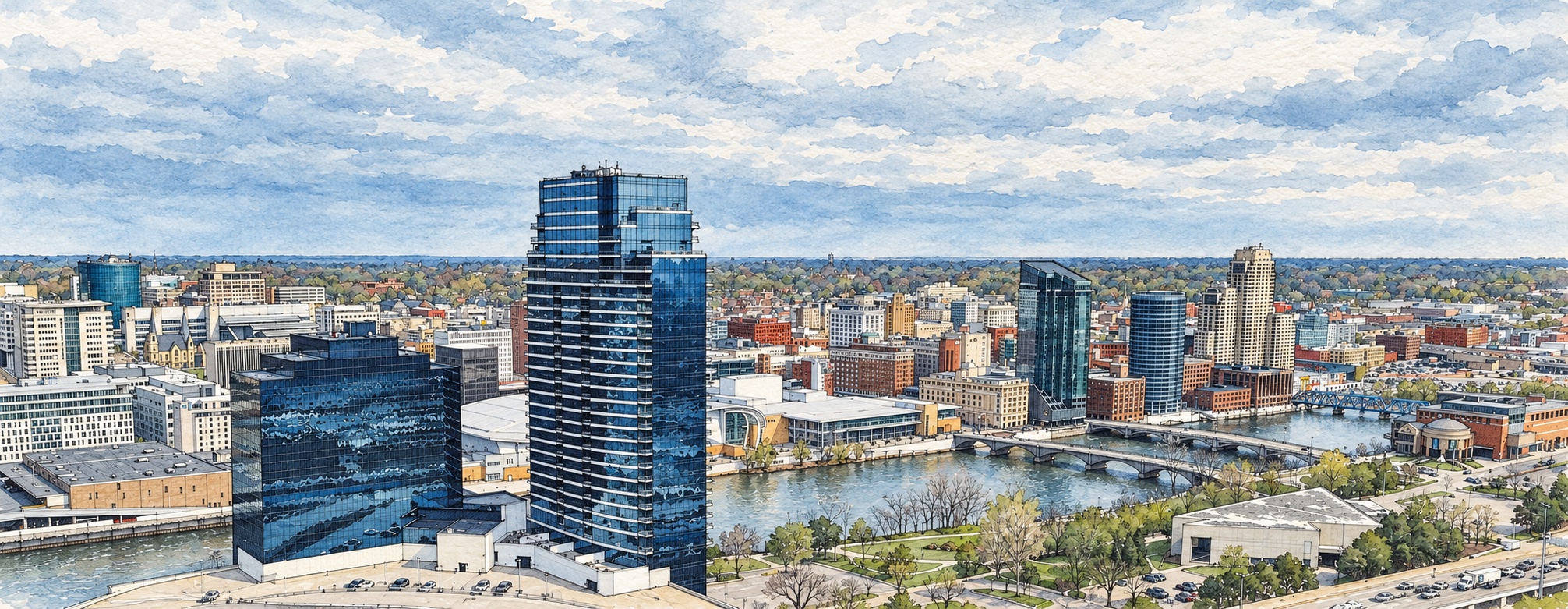
Watercolor and pen-and-ink interpretation of a photograph by WMrapids / Wikimedia Commons (CC0). Original photograph: Grand Rapids skyline, April 2022.
You can fall for downtown Grand Rapids in a single showing. A skyline view. A quick walk to a museum or a concert. The idea that you can park once and live lighter.
But downtown condo living is less about the view and more about the systems: the HOA budget, the elevator, the parking assignment, the rules on rentals, the reserve study, the loading dock, and how you actually move through the city on an average Tuesday.
This is the practical promise of downtown ownership: if you choose the right building and the right micro-location, you can get a lifestyle that feels more “membership” than “maintenance.” Choose wrong, and you’ll feel boxed in by policies you didn’t realize you were buying into.
Quick takeaways
- Downtown condo life is document-heavy. The HOA’s reserves, rules, and upcoming projects matter as much as finishes and square footage.
- Parking and mobility are part of the purchase. The DASH shuttle and the City’s parking lots and ramps can be lifestyle upgrades, but only if your building’s setup matches your routines.
- Downtown is changing along the river. The City’s Grand River Revitalization Project includes construction staging at Ah-Nab-Awen Park, which can affect access and “quiet enjoyment” near the river for a period of time.
What “downtown” means in real life (hint: it’s a set of neighborhoods)
When someone says they’re “moving downtown,” they might mean a loft near the Market District. Or a condo closer to the arena. Or a river-facing unit where the trail becomes the default evening walk. Those differences don’t feel like semantics once you own.
One useful way to think about downtown is as a handful of small districts with distinct rhythms, which Downtown Grand Rapids Inc. (DGRI) outlines in its overview of downtown neighborhoods. Your daily life will be shaped by which direction you naturally walk: toward the river, toward the arena, toward the museum district, or toward the Market District.
Practical relocation move: before you pick a building, pick your “default loop.” If your loop includes the river trail, that’s a very different ownership experience than living where your loop is mostly streets, sidewalks, and event nights.
The homes: what you’re actually buying downtown
Downtown Grand Rapids ownership is typically about condos (including adaptive-reuse loft style buildings and newer multi-story developments) and, in certain pockets, townhome-style living on the edges. The lifestyle draw is obvious. The real estate tradeoffs are quieter:
- Storage and utility space: Some buildings are generous, some are tight. Ask where bikes live. Ask where seasonal gear goes. Ask about assigned storage units and how they’re secured.
- Vertical living realities: Elevators, common hallways, package delivery protocols, and building access systems matter. These are not “nice-to-have” details; they are quality-of-life.
- Windows and exposure: Downtown units can vary widely in natural light, street noise, and privacy depending on orientation. The same floor plan can feel totally different on a different corner of the building.
Downtown buyers often underestimate how much of their purchase is shared infrastructure. Which brings us to the real due diligence.
The HOA is your second mortgage (even when the dues aren’t huge)
I’m not being dramatic. In condo ownership, the HOA is the entity that maintains the systems you can’t individually control. A well-run HOA can make downtown living feel effortless. A poorly-run HOA can turn a beautiful condo into a recurring set of surprises.
Condo due diligence checklist (the version that protects you)
- Budget and reserves: Ask for the current budget, reserve balance, and reserve study (if available). You are looking for a story that makes sense: what they maintain, what they save, and what they plan.
- Special assessments history: Not all special assessments are “bad” (sometimes it means the building is being cared for). But you want context: why, how often, and whether there are more projects queued up.
- Rules that affect your future: Pet policies, leasing/rental limits, short-term rental restrictions, move-in fees, and renovation guidelines. If you think you might rent the unit later, those rules are not a footnote, they’re the plan.
- Insurance structure: Understand what the HOA’s master policy covers versus what your individual policy must cover. (This is a conversation for your insurance professional, but you want clarity before you commit.)
- Lender and financing considerations: Some buildings are easier to finance than others depending on owner-occupancy ratios, budgets, and insurance details. This is where your lender and your agent need to work together early.
Downtown buyers who feel great a year later are usually the ones who treated condo documents like a home inspection: not as paperwork, but as the building’s operating manual.
Mobility: downtown can be a one-car lifestyle (or a two-car headache)
Downtown living rewards people who design a routine. The City’s Mobile GR department makes that easier in two concrete ways:
- The DASH: The Downtown Area Shuttle (DASH) is a city-supported downtown shuttle network, and DGRI describes it as a free service available seven days a week on its DASH Downtown page.
- Parking management: If you use street parking, the City provides guidance for its mobile payment system through the MOTU App Guide, and it also publishes information on City parking lots and ramps.
Translation: your condo choice should reflect whether your life is “park once,” “commute out daily,” or “weekend-event heavy.” Don’t let the building pick your mobility habits by accident.
The river is becoming a bigger part of downtown living (and there are near-term disruptions)
Downtown’s outdoors life is not just a summer perk. It’s part of the ownership value proposition if you’re close to the river corridor.
On the recreational side, the Grand River Edges Trail is one of the key non-motorized connectors along the river near downtown. And Riverside Park is not just “a park,” it’s an activity anchor. Grand Rapids Parks & Recreation runs kayak rentals at Riverside Park, which is a great example of downtown life expanding beyond sidewalks and patios.
On the construction side, the City’s Grand River Revitalization Project has identified Ah-Nab-Awen Park as a main staging area, with closures tied to construction schedules. If you’re buying a river-adjacent condo, this matters. It can affect access routes, trail continuity, views, and noise. None of that should necessarily stop you, but it should be part of the timing conversation.
Culture and events: the “season pass” value of living downtown
Downtown Grand Rapids can feel like you’re living inside a calendar. The goal isn’t to do everything. It’s to have the option to do something without turning it into a drive-and-park production.
- Performing arts: DeVos Performance Hall anchors a big slice of the city’s show schedule.
- Arena nights: Van Andel Arena pulls concerts and sports into the core, which is both a lifestyle perk and a noise/traffic consideration depending on proximity.
- Museums you’ll actually use: The Grand Rapids Art Museum and the Grand Rapids Public Museum are the kind of amenities that change how a random weekend afternoon gets spent.
- Seasonal rituals: The City’s Rosa Parks Circle Ice Rink is a specific downtown winter perk that downtown residents can enjoy without planning their entire evening around it.
- Food hall gravity: The Grand Rapids Downtown Market functions as more than a “place to eat,” especially if you’re close enough to treat it like a pantry stop. It’s also a venue for seasonal programming like the Grand Rapids Christkindl Markt.
Want downtown energy without downtown rules? Here’s the alternative move.
Some buyers love downtown’s restaurants, venues, and river corridor, but they don’t want HOA governance, shared walls, or elevator dependence. In that case, the decision is not “downtown or not.” It’s “downtown address vs. downtown access.”
That’s where close-in neighborhoods and edge-of-downtown pockets become strategic. You trade immediate walkability for more autonomy: a garage that’s yours, a yard or patio you control, fewer shared systems, and often a different renovation and maintenance profile.
The key is being honest about what you’re optimizing for: a view and a calendar, or control and space with quick access.
A smart next step before you buy
If you’re considering downtown Grand Rapids, I’d encourage one practical move: pick two or three buildings (or even specific units) and do a “systems review” before you fall too hard for finishes. We’ll look at the HOA documents, parking realities, any upcoming projects, and the micro-location factors that don’t show up in listing photos.
If you want, send me (1) your price range, (2) whether you need secure parking and how many vehicles, and (3) two listings you like. I’ll help you pressure-test which downtown lifestyle you’re actually buying, and what deserves a closer look before you commit.