
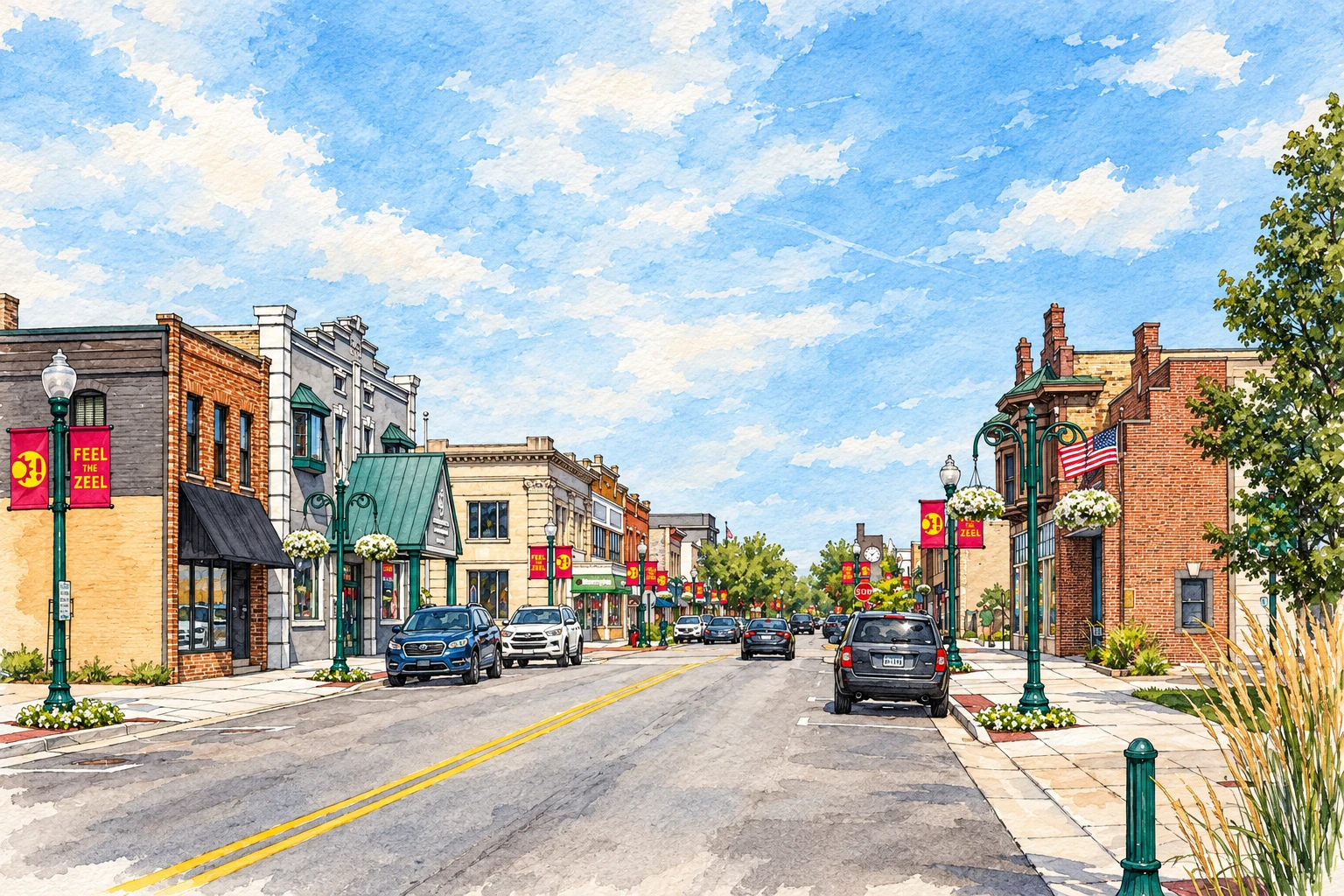
You know that feeling when a place is actually used, not just visited? Where downtown is not a once-a-month outing, it’s a Tuesday-night routine. Zeeland is like that. A compact Main Avenue, public parks that function as living rooms, and enough day-to-day convenience that you do not have to “save everything for Holland.”
But there’s a real estate catch, and it’s a big one: in Zeeland, the decision isn’t only “Which neighborhood?” It’s also “City address or Township address?” That one choice tends to reshape everything from lot size and home style to utilities, road feel, and how close you are to the parts of Zeeland you’ll actually use.
Start downtown: Zeeland is intentionally building a “linger” culture
Zeeland’s downtown has a Social District, which is the city’s way of letting adults 21+ purchase a beverage from participating license holders and enjoy it within designated boundaries, including public spaces like Elm Street Park. The City publishes the rules and even lists current license holders. That detail matters, because it tells you two things: (1) downtown is meant to be walked, and (2) events and seasonal weekends are not hypothetical here, they are planned for. ([cityofzeeland.com](https://www.cityofzeeland.com/downtown-zeeland/))
If you want a quick mental picture: it’s the kind of downtown where you might grab a drink from Tripelroot (brewpub, deli, and market) and then actually use the public space instead of heading straight back to your car. ([tripelroot.com](https://tripelroot.com/about/?utm_source=openai))
A real “third place” tells you what to buy
Relocating buyers often underestimate how much their house choice should be shaped by the place they’ll spend the unplanned hours. In Zeeland, that “third place” might be:
- Elm Street Park, a downtown gathering spot inside the Social District, with an ice rink setup and free skate rentals (seasonal operations and rules are published by the city). ([cityofzeeland.com](https://www.cityofzeeland.com/parks/elm-street/?utm_source=openai))
- Vande Luyster Square, a small but meaningful downtown green space with a gazebo and fountain, also within the Social District. ([cityofzeeland.com](https://www.cityofzeeland.com/parks/vande-luyster-square/?utm_source=openai))
- La Crème, a downtown café built around crêpes and coffee, with posted hours and its Zeeland address right on its site. ([lacrememichigan.com](https://lacrememichigan.com/?utm_source=openai))
When those places become part of your normal week, you start caring about different home features: a walkable route, an easy bike ride, a garage setup that makes it painless to come and go, and a floor plan that fits “friends over after downtown” without feeling like you need a formal entertaining wing.
A Saturday in Zeeland (the version that helps you choose the right house)
This is editorial scene-setting, not a claim of personal attendance.
Morning starts downtown with coffee at 6eight (listed locally as a Zeeland coffee shop, and also shown in the West Coast Chamber directory). ([business.westcoastchamber.org](https://business.westcoastchamber.org/member-directory/Details/six-eight-cafe-boutique-at-better-way-designs-the-884423?rendermode=print))
From there, you do what Zeeland makes easy: you stitch together small experiences. Maybe a slow brunch at La Crème. Maybe a walk through the Social District footprint just to see what feels active. ([lacrememichigan.com](https://lacrememichigan.com/?utm_source=openai))
Later, you grab lunch at StrEATs Taco Kitchen, which posts its Zeeland location and hours (Tuesday to Saturday, 11am to 8pm at the time of writing). ([streatstacokitchen.com](https://streatstacokitchen.com/?utm_source=openai))
In the afternoon, you end up in a park, because Zeeland has a deep bench of them. The City’s parks listing is surprisingly useful for relocators because it shows how “local recreation” is distributed across town and what each park is designed for. ([cityofzeeland.com](https://www.cityofzeeland.com/parks/))
For example, the City describes Huizenga Park as a large community park with features like a skate park, shelters, athletic fields, pickleball courts, trails, a playground, and a fishing pond. That tells you something about how people spend time here, and it also hints at where weekend traffic and parking patterns will show up. ([cityofzeeland.com](https://www.cityofzeeland.com/parks/))
Then fall hits, and Zeeland’s festival calendar becomes part of the town’s rhythm. Zeeland Festivals publishes an events lineup that includes Pumpkinfest, Zeelmania, a Memorial Day parade, and a Magical Christmas Parade. For 2026, Pumpkinfest was listed for October 2 to October 3, 2026, which (as of today, October 5, 2026) is already in the past. Still, the point for a buyer is bigger than one weekend: if you own close to downtown, you should expect periodic road closures, crowds, and “fun noise,” and decide if that is a feature or a bug. ([zeelandfestivals.com](https://www.zeelandfestivals.com/pumpkinfest))
What the homes feel like: three Zeeland “ownership styles”
Instead of pretending Zeeland is one uniform housing market, it’s more helpful to think in ownership styles. These are broad patterns, not hard lines, and any specific property should be evaluated on its own merits.
1) In-town Zeeland (City) homes: sidewalk proximity and classic neighborhood rhythm
If your ideal life includes: “I can be downtown quickly, I can use the Social District without planning a parking strategy, and I want the city to feel like a place I belong,” you gravitate toward the City of Zeeland core.
Homes here often lean older and more established in feel. That can mean charm, but it also means you should budget for the unglamorous realities: older mechanicals, older sewer lines on older homes, and renovations done across multiple decades. Your inspection strategy matters.
Real estate move that fits: prioritize location and layout over cosmetic updates. Cosmetic is fixable. A great-in-photos house that makes you drive to do the Zeeland things you moved for is a slow-burn regret.
2) Zeeland Township edges: newer neighborhood patterns and “drive-to-downtown” convenience
Many buyers want Zeeland’s general location and culture, but with newer construction patterns, more garage-forward homes, or subdivision living. Township addresses can deliver that, often with a different feel: more space between homes, newer streetscapes, and a “quick drive” relationship to Main Avenue.
Real estate move that fits: evaluate the micro-location like you would in any newer area: HOA rules, sidewalk connectivity, stormwater features, and how you actually enter and exit during peak times.
3) The semi-rural Zeeland orbit: land, outbuildings, and the “weekend-at-home” lifestyle
Because Zeeland is surrounded by farmland and outlying land (and the city is literally described as being on a hill above surrounding township land), there are buyers who treat Zeeland as an anchor point for a more land-forward lifestyle. ([en.wikipedia.org](https://en.wikipedia.org/wiki/Zeeland%2C_Michigan))
Real estate move that fits: treat the land like a second property. Ask about drainage, neighboring uses, outbuildings, well and septic (if applicable), and what you can actually do with the parcel, not what you hope you can do.
The big decision: Zeeland City address vs. Zeeland Township address
In practice, “Zeeland” on a mailing label can mean meaningfully different day-to-day ownership.
- Walkability vs. drivability: If you want to use downtown like a living room, the city core changes your week. The City’s Social District explicitly includes public spaces like Elm Street Park and lists participating downtown establishments. That’s a lifestyle system, not just a cute idea. ([cityofzeeland.com](https://www.cityofzeeland.com/downtown-zeeland/))
- Utilities and infrastructure expectations: City properties more often align with municipal service patterns; township properties may vary more by area. Do not guess. Confirm with the municipality and with your inspection team.
- Lot size and privacy expectations: Township options often attract buyers who want more elbow room without fully leaving the Holland and Grand Rapids orbit.
The right way to choose is not “Which is better?” It’s “Which version of Zeeland matches how I actually live?”
Due diligence notes that matter specifically in Zeeland
1) If you want downtown energy, learn the Social District boundaries and rules
This sounds minor until you own two blocks from the action. The City’s Social District page spells out hours, boundaries, and even that beverages must come from current license holders (listed by name). It also calls out that alcohol in the Splash Pad is off-limits unless otherwise posted. That kind of specificity is exactly what a buyer should read before assuming how a downtown weekend works. ([cityofzeeland.com](https://www.cityofzeeland.com/downtown-zeeland/))
2) Parks are part of the “daily-life infrastructure,” not just recreation
The City lists its parks and describes what each one is equipped for, including features like the splash pad, pathways, and larger community parks. If you are deciding between two neighborhoods, “Which park will we actually use?” is a very practical tiebreaker. ([cityofzeeland.com](https://www.cityofzeeland.com/parks/))
3) Zeeland has some cultural quirks worth understanding, especially if you are relocating
The City’s own history page includes details like Zeeland historically never licensing a movie theater, and it describes traditional Sunday observance practices from earlier eras. Whether or not that matches today’s daily routines, it’s useful context for understanding why the town’s culture feels different than a purely tourism-driven lakeshore downtown. ([cityofzeeland.com](https://www.cityofzeeland.com/history/?utm_source=openai))
If Zeeland is close, but not quite: what to compare next
Zeeland is often a “middle choice” in a good way. If you want to pressure-test it, compare it against:
- Holland for a bigger downtown footprint and a different lakeshore-adjacent rhythm.
- Hudsonville or Jenison if your priority is newer neighborhood inventory and quick highway access, with less emphasis on a walkable downtown core.
- Grand Rapids suburbs if your daily gravity is more city-centric than lakeshore-centric.
The Switek-style bottom line
Zeeland is compelling because it’s not trying to be a vacation town. It’s a place that’s engineered for repeat visits by the people who live there, with a downtown that’s meant to be used and a “city vs. township” choice that lets buyers dial in how close they want to live to the action.
If you’re considering Zeeland, tell me where you’re moving from, your price range, and which version of day-to-day you want: walk-to-downtown, newer-neighborhood convenience, or land and breathing room. I’ll help you sort out whether you should start in the City, the Township, or a totally different West Michigan move before you fall in love with the wrong house.