
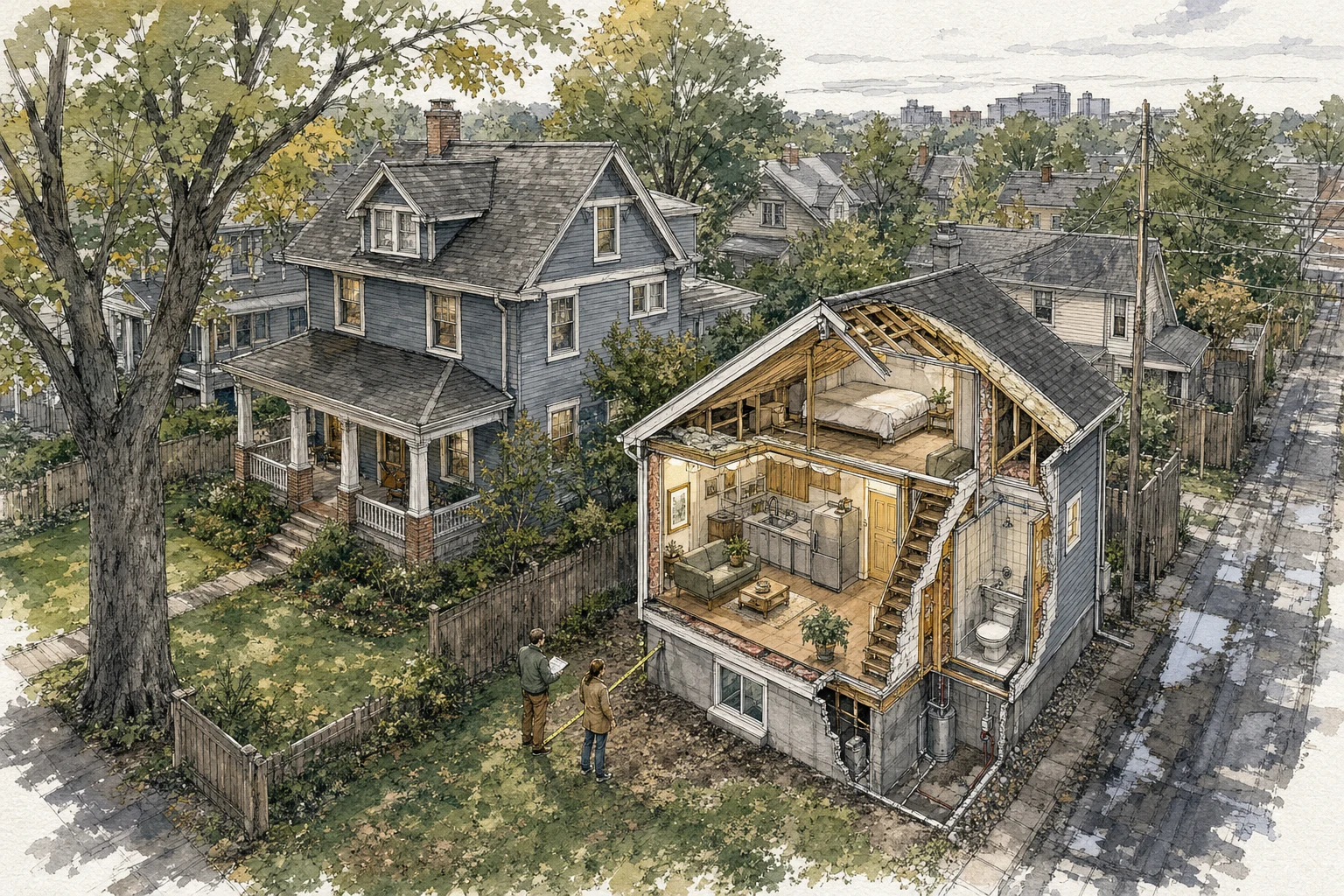
In West Michigan, an “apartment over the garage” can be a smart flexibility play. It can also be a closing problem hiding in plain sight. The surprise is not usually the drywall or the kitchenette. It’s the jurisdiction line.
Inside the City of Grand Rapids, ADUs have a clear path and (as of the city’s recent reforms) fewer of the old tripwires. A few miles away, you can run into tighter size limits, extra parking requirements, historic review, or a flat-out prohibition on creating a second dwelling unit in a detached building.
This guide is the 2026 reality check for buyers and sellers in Greater Grand Rapids who want an ADU for rental income, multi-generational living, caregiver space, a home office that can actually be a separate unit, or a future-proof resale feature.
Quick takeaways
- Grand Rapids: ADUs can be rented and do not require owner-occupancy, but you still have to fit size, height, and placement rules and pull the right permits. See the City’s Accessory Dwelling Units FAQs (Feb 2025).
- Nearby rules vary wildly: East Grand Rapids allows ADUs with its own standards (including restrictions like no short-term rental use), while Cascade Township’s adopted 2026 zoning ordinance states Accessory Dwelling Units Prohibited. Compare East Grand Rapids Zoning Code § 5.70 and Cascade Township Zoning Ordinance (adopted Feb 11, 2026).
- Pricing and offers should treat “ADU potential” as conditional: confirm zoning, permitting, utilities, and rental registration rules before you pay for potential that might not exist.
First: what the city means by “ADU” (and why appraisers and lenders care)
In Grand Rapids, the city describes an ADU as a secondary, subordinate dwelling unit that can be within the house, within an accessory structure, or separate but on the same lot, subject to standards. The city’s own ADU FAQ is worth reading because it captures the practical constraints buyers trip over: where it can sit, how big it can be, and what review is required.
Why it matters in a transaction: as soon as a property functions like “two dwelling units,” you can trigger different building code expectations, different rental compliance obligations, and sometimes a different underwriting and appraisal conversation. Grand Rapids’ guidance notes that ADUs attached to, or within a home, are treated as a duplex or two-family structure for building code purposes. (That is not a guarantee of how every lender will classify your loan, but it is a flashing yellow light to confirm financing early.) See Q9 in the City ADU FAQ.
Grand Rapids (2026): the practical rules you should actually underwrite
Location and placement
Grand Rapids allows ADUs in several configurations, and the placement rules differ depending on whether it is attached, internal, or detached. The city’s FAQ highlights that ADUs in separate structures may not be located forward of the house and must meet minimum separation distances (for example, at least 6 feet from the house and at least 3 feet from side and rear lot lines, plus spacing from other accessory structures). Those basics are laid out in the Grand Rapids ADU FAQ.
Size and height
In the City of Grand Rapids, the FAQ states an ADU must be at least 400 square feet and no more than 850 square feet, with exact sizing depending on parcel and standards. It also notes a detached ADU can be no taller than 25 feet. Source: Grand Rapids ADU FAQ (Feb 2025).
Renting and owner-occupancy
Grand Rapids’ FAQ is explicit that ADUs can be rented and that neither the primary structure nor the ADU must be owner-occupied. It also notes that rent-based occupancy units must be registered with the city and follow renting regulations. Source: Grand Rapids ADU FAQ. For the city’s rental compliance framework, start with the City of Grand Rapids Rental Certification Program page and confirm what applies to your exact use and configuration.
Historic districts: a separate approval layer
If the property is in a historic district, the ADU concept can still be workable, but the review path can change. The city’s ADU FAQ notes that ADUs on property in an historic district may need a Certificate of Appropriateness. If this applies, use the City’s Historic Preservation Commission Certificate of Appropriateness information as a starting point and confirm scope with staff before you price a build plan.
Permits and trades: assume more than one permit
At the state level, Michigan’s building permit guidance makes the general rule simple: permits are required before undertaking regulated construction, alteration, and system work, with only narrow “ordinary repairs” carved out. Source: Michigan LARA Building Permit Information.
At the city level, Grand Rapids provides a dedicated ADU building application link and notes that multiple permits may be required depending on scope. Source: City of Grand Rapids Residential Building Permits.
Utilities and mechanical considerations that affect budget and feasibility
Grand Rapids’ ADU FAQ includes utility and building code points that can move the budget fast, including guidance that an ADU meeting the criteria may be served for water downstream of the primary residence meter, and notes expectations like separate air handling systems for the main house and the ADU. Source: Grand Rapids ADU FAQ. Treat these as early design constraints, not late-stage surprises.
Two nearby examples that prove the point: “Greater GR” is not one rulebook
East Grand Rapids: allowed, but with its own guardrails
East Grand Rapids recognizes and regulates ADUs within its zoning code, with standards that differ from Grand Rapids. For example, the city code includes minimum and maximum ADU sizes, rear-yard placement standards for detached and garage ADUs, and a statement that an ADU shall not be used as a short-term rental, bed and breakfast, or other non-allowed use. See East Grand Rapids Zoning Code § 5.70.
The practical takeaway: do not assume “I saw this in Grand Rapids” transfers cleanly across the city line. Even if the ADU is legal, the design box might be smaller and the use limitations might be sharper.
Cascade Township: a clear prohibition that buyers miss when touring “nice garage space”
Cascade Township’s adopted zoning ordinance includes a direct prohibition on accessory dwelling units in detached accessory buildings, and it goes further by prohibiting a detached accessory building from containing a kitchen, a toilet, and a bathtub/shower under any circumstances. That language matters because it can turn a “future guest suite” plan into a non-starter. Source: Cascade Township Zoning Ordinance (adopted Feb 11, 2026).
The offer-stage ADU checklist (buyers and sellers)
If an ADU is part of the value, treat it like due diligence, not a vibe. Here’s the checklist that keeps deals from drifting into “we’ll figure it out later” territory.
- 1) Confirm the jurisdiction. “Grand Rapids mailing address” is not the same as being inside the City of Grand Rapids. Determine the actual municipality that controls zoning and permits.
- 2) Pull the actual rule, in writing. Start with the municipality’s published ordinance or staff FAQs, not a blog summary. For Grand Rapids, use the City ADU FAQ and the City’s Development Center resources like Residential Building Permits.
- 3) Stress-test the site plan. Setbacks, “not forward of the house,” separation from the primary structure, and greenspace coverage rules can kill a detached ADU even when the zoning district is friendly.
- 4) Ask for the paper trail. If the ADU already exists, request permits, final inspections, and any rental registrations. If it does not exist, ask what permits will be required and who can pull them. (Michigan’s baseline is permits for regulated work, per LARA.)
- 5) Verify utilities and systems early. Water and sewer connection approach, metering, mechanical separation, and fire separation details can be cost drivers. Grand Rapids flags several of these points in its ADU FAQ.
- 6) Confirm the allowed use you actually want. Long-term rental, short-term rental, or “family use only” can be treated differently by different municipalities. For example, East Grand Rapids’ code states ADUs shall not be used as short-term rentals. See EGR § 5.70.
- 7) Underwrite financing and appraisal risk. If the ADU is attached or internal, some parties may treat the property more like a two-family structure. Grand Rapids notes the building code treatment as a duplex/two-family for attached/within-home ADUs. Source: Grand Rapids ADU FAQ. Talk to your lender before you assume a standard 1-unit appraisal path.
How to price “ADU potential” without overpaying (or overpromising)
Most ADU mistakes in negotiations are not technical. They are language mistakes.
Sellers: “ADU possible” should mean “we verified the municipality and know what it would take,” not “there’s room behind the garage.” If you have not verified it, say that plainly and price accordingly.
Buyers: If the ADU is the reason you are stretching on price, tie your offer strategy to verifiable milestones: zoning confirmation, permit feasibility, and (if applicable) rental registration requirements. When the rulebook is restrictive, you may be negotiating for a different asset than you think you are buying.
A practical next step
If you are looking at a specific address in Grand Rapids, East Grand Rapids, or a nearby township and the ADU question affects your price, send the address and the intended use (long-term rental, guest space, caregiver unit, etc.). I will help you build a simple, written “yes/no/conditions” checklist from the municipality’s own rules so your offer, timeline, and renovation budget are grounded in reality, not optimism.