
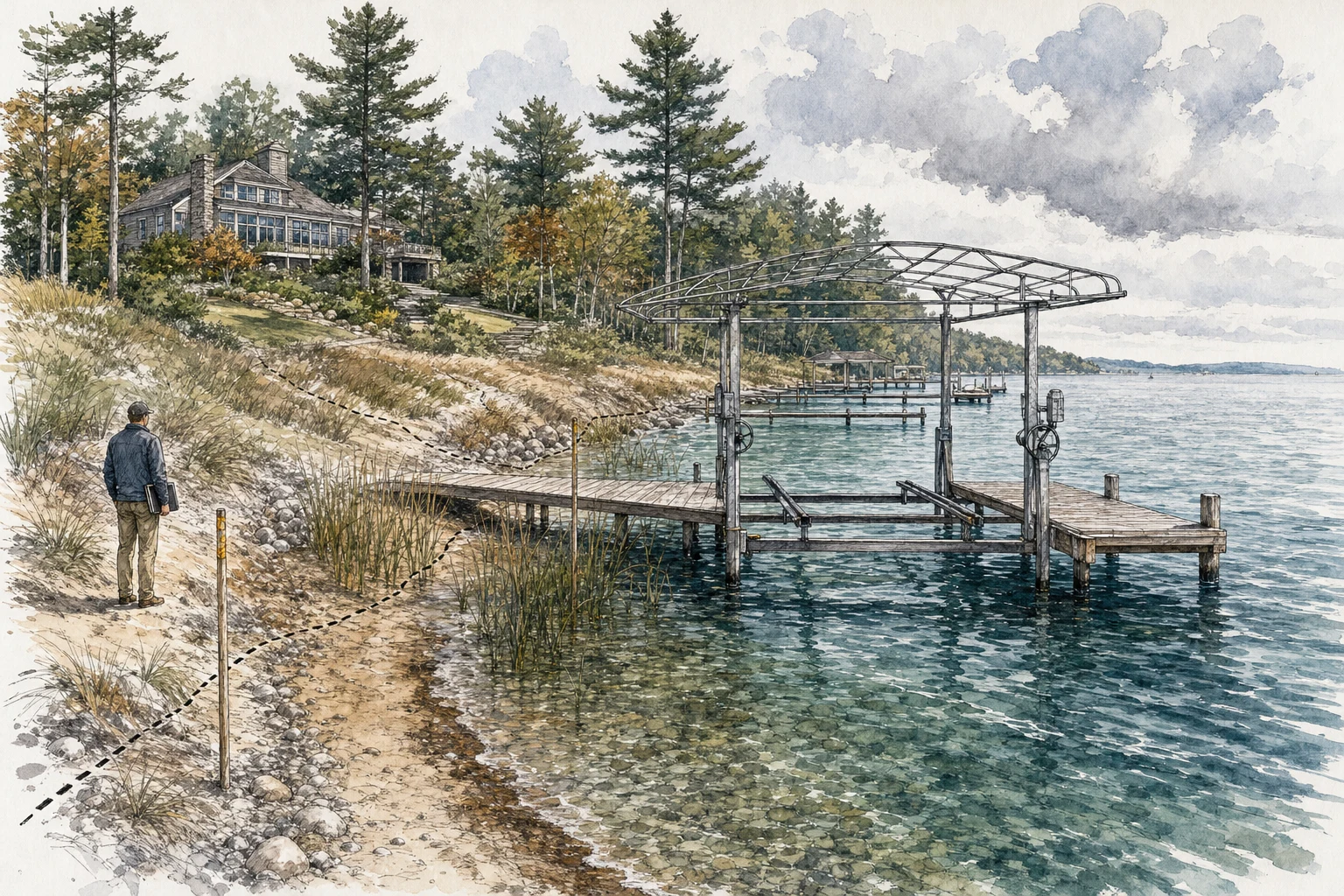
A waterfront listing photo can create a very expensive assumption: that the dock you see is the dock you get, and that you can replace it, extend it, or add a lift whenever you feel like it.
In West Michigan, docks and hoists live at the intersection of three things that do not always agree: (1) property rights (riparian or littoral rights), (2) state and federal regulation (EGLE and, in some waters, the U.S. Army Corps of Engineers), and (3) local rules (township ordinances, lake associations, HOA bylaws, deed restrictions).
This guide is the practical, deal-oriented version of the question I hear constantly: “Can I put a dock in?” You usually can. The better question is what kind, where, under what approvals, and on what timeline.
Quick takeaways
- Inland lakes: EGLE generally says a seasonal, private, non-commercial dock or hoist that does not unreasonably interfere with others and is not placed in wetlands does not require an EGLE permit, but permanent structures often do.
- Great Lakes (including Lake Michigan): EGLE states that permits are required for many structures (including docks and boat lifts) placed on Great Lakes bottomlands below the statutory Ordinary High-Water Mark (OHWM).
- For closings: treat dock rights and approvals like septic or well due diligence. Verify you have riparian rights, verify rule layers (EGLE + local + HOA), and write the offer timeline so you are not discovering a permit problem in the final week.
Step 1: Confirm you actually have riparian (or littoral) rights
Michigan case law generally recognizes that waterfront owners have riparian or littoral rights, and those rights commonly include the ability to place a dock, subject to reasonableness and regulation. A frequently-cited Michigan Supreme Court decision describes dock placement as part of riparian or littoral rights (see Thies v. Howland (Michigan Supreme Court)).
But in transactions, the “riparian rights” question is not academic. It is a document problem.
Common situations that create surprises
- Backlot access easements: Some non-waterfront parcels have an easement to use a waterfront strip or a common outlot. Sometimes that easement is limited to “access” only. Sometimes it includes mooring or dock rights. The words matter, and disputes happen.
- Canal lots and shared channels: A canal can still be regulated, and a “channel lot” can have very different practical dock options than a broad open shoreline.
- Artificial water bodies: Michigan courts have stated that riparian rights do not arise from an artificial body of water (see Holton v. Ward (Michigan Court of Appeals)). If a “lake” is really a man-made pond, you want to understand what rights exist, and who controls them.
Closing takeaway: if the ability to place or keep a dock is important to your purchase, treat the title work, easements, and association documents as primary due diligence, not an afterthought.
Step 2: Inland lake docks: seasonal is usually simpler than permanent
For inland lakes and streams, EGLE administers Part 301 (Inland Lakes and Streams) of NREPA. EGLE’s overview is unusually buyer-friendly because it states the practical rule many owners live by: seasonal docks and hoists generally do not require a permit if they meet certain conditions (private, non-commercial use by a landowner, not unreasonably interfering with others, not interfering with water flow, and not placed in wetlands). See EGLE Inland Lakes and Streams overview.
EGLE also has a straightforward handout that draws a bright line many buyers miss: permanent docks or permanent hoists may require a permit, while seasonal, removable structures may not, depending on conditions. See EGLE handout: Docks, Boat Hoist, and Swim Rafts on Inland Lakes (PDF).
A practical way to think about it
- Lower permitting risk: a typical seasonal dock and seasonal lift/hoist that come out each year, placed so they do not interfere with neighbors’ use or navigation, and not in wetlands.
- Higher permitting risk: dredging, fill, seawalls, permanent pilings, boat wells, expanded marina-style frontage, or anything that changes bottomlands or flow. Those tend to move you into Joint Permit Application territory.
Important: “No permit required” is not the same as “do anything you want.” Even seasonal structures can create disputes if they interfere with navigation or neighbors’ reasonable use.
Step 3: Lake Michigan and the Great Lakes play by different rules
Lake Michigan properties feel like the ultimate “set it and forget it” lifestyle until you learn about bottomlands and the Ordinary High-Water Mark (OHWM).
EGLE’s Great Lakes Submerged Lands program explains that permits are required for many construction activities and the placement of structures such as docks, boat lifts, or seawalls on Great Lakes bottomlands below the statutory OHWM. See EGLE Great Lakes Submerged Lands construction permits.
Why the OHWM matters in real estate terms
In plain English: where your lot meets the water is not always where the state’s regulated boundary is. EGLE explains that the OHWM for Great Lakes is set by Part 325 and can be discussed both as an elevation and as a location on the ground. See EGLE Ordinary High Water Mark (OHWM).
Part 325 also sets the statutory OHWM elevation for Lakes Michigan and Huron at 579.8 feet (International Great Lakes Datum of 1955). See MCL 324.32502 (Great Lakes Submerged Lands OHWM elevations).
Closing takeaway: If you are buying on Lake Michigan (or other Great Lakes shoreline), assume you will need a more formal permitting conversation for docks and shoreline structures than you would on a typical inland lake.
Step 4: The Joint Permit Application is the center of gravity
When a waterfront project crosses into regulated activity, the paperwork you will hear about most is the EGLE and U.S. Army Corps of Engineers Joint Permit Application (JPA). EGLE describes the JPA as a way to avoid duplicative state and federal permitting for “land meets water” activities. See EGLE Joint Permit Application and EGLE FAQ: Land and Water Interface Project Permitting.
EGLE’s FAQ also notes that if a project is in Section 10 waters (including the Great Lakes), the permit application is sent to the Detroit District Office of the U.S. Army Corps of Engineers for federal processing. See the same EGLE permitting FAQ.
If you want the federal-side, applicant-facing summary, USACE also states that under Section 10 a permit is required for work or structures in navigable waters, and in Michigan applicants are directed back through the state’s joint permit process. See USACE Regulatory Request System: Permitting overview.
Step 5: Do not forget the “fourth regulator”: your lake association or HOA
Even if EGLE does not require a permit for your seasonal dock on an inland lake, you may still face restrictions from:
- Recorded deed restrictions (often older, sometimes surprisingly strict)
- Lake association rules (especially around shared frontage, channel width, or “one dock per lot” concepts)
- Condo or HOA bylaws (common on channels and planned developments)
- Local ordinances (some municipalities regulate dock location, seasonal dates, or shoreline work, particularly where public safety or navigability is a concern)
These rule sets can create a classic closing trap: the buyer assumes the presence of a dock equals the right to keep it, but the association sees it as a revocable privilege, a limited common element, or something that requires annual approval.
Step 6: A closing-safe dock checklist (buyer and seller version)
Use this as a transaction checklist before you treat “dock included” as real value.
1) Rights and documents
- Confirm the parcel is riparian or littoral, or understand the exact waterfront easement language if it is not.
- Request association bylaws, rules, and any dock assignment maps (if applicable).
- If the shoreline is shared or oddly shaped, consider a surveyor and a riparian boundary conversation early, not after inspections.
2) What kind of structure is it?
- Is the dock seasonal and removable, or permanent?
- Is there a boat lift/hoist or only tie-off?
- Is there evidence of dredging, a boat well, or other bottomlands work?
3) EGLE and federal layer
- For inland lakes, compare your plan to EGLE’s seasonal dock criteria in the EGLE Inland Lakes and Streams overview.
- For Great Lakes shoreline, start with EGLE Great Lakes construction permits and confirm where the OHWM applies using EGLE’s OHWM guidance.
- If you might need approvals, budget time for the Joint Permit Application process.
4) Special scenario: “road ends” and shared public access
Inland lake “public road ends” are a recurring dispute category in Michigan. State law restricts using a public road end to build or use docks beyond a limited seasonal public dock authorized by the local unit of government, subject to any required permits. See MCL 324.30111b (public road end docks).
Closing takeaway: If a property is marketed with “road end access,” treat dock and mooring rights as unproven until the documents say otherwise.
Offer strategy: price the dock question like any other major due diligence item
When dock rights are central to the property’s utility, the offer should not depend on a handshake understanding or a casual email from an association volunteer.
- Ask for written documentation of association dock rules and assignments.
- Build a timeline that allows for EGLE questions or permit feasibility, not a rushed “figure it out after inspections” approach.
- Clarify what conveys: dock sections, lifts, anchors, wheels, permits, and any storage racks. If a dock is leased or serviced under a contract, understand whether the contract can transfer.
If you are selling, the same logic applies in reverse. A clean package of documents about dock rights, association rules, and any approvals reduces the odds that a buyer asks for a last-minute concession because they learned the dock situation is more limited than expected.
A practical next step
If you are looking at a West Michigan waterfront purchase or preparing to list one, I can review the listing, the association documents (if any), and the shoreline context with you and help you build a closing-safe plan for verifying dock rights and approval risk before you bet the deal on assumptions.