
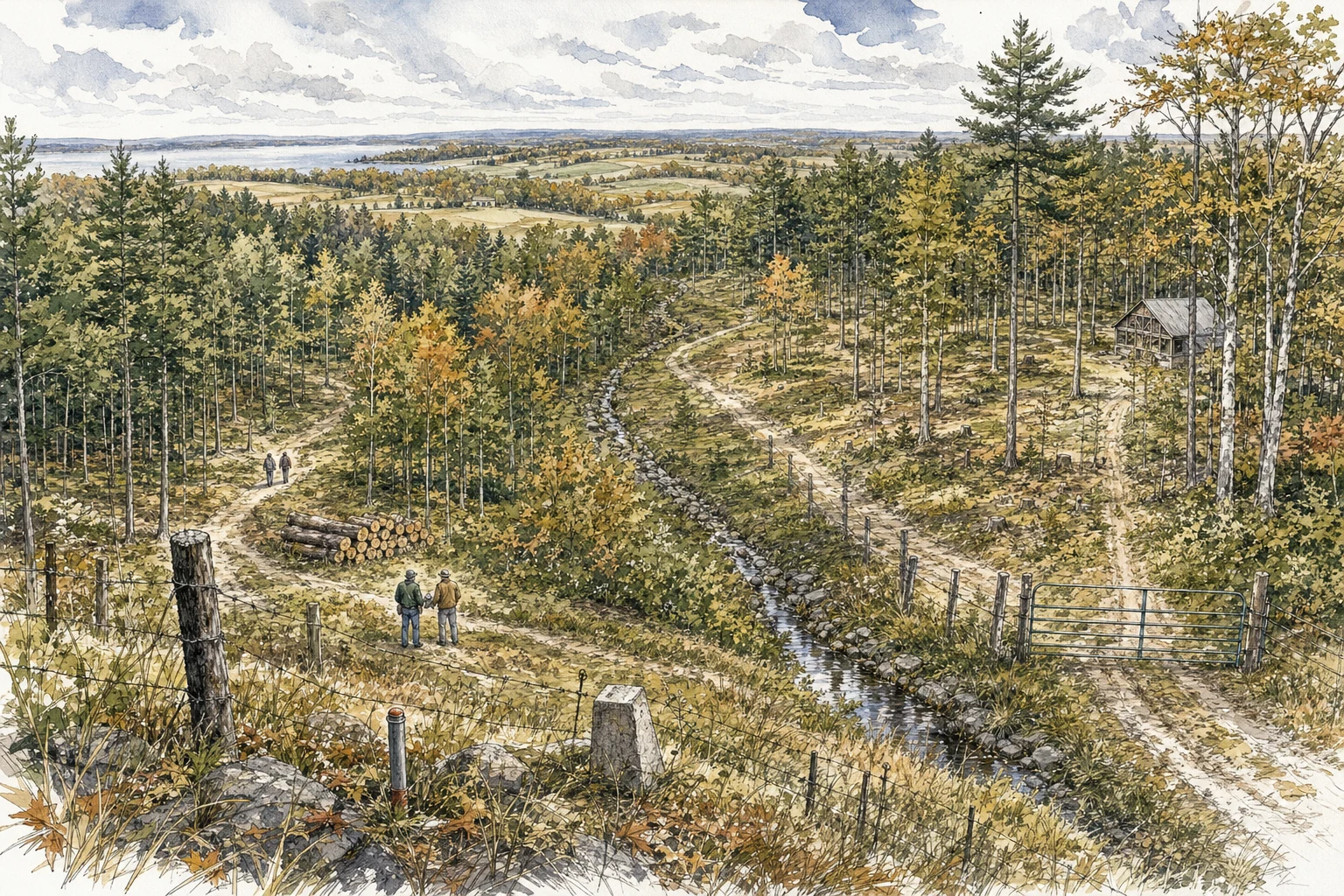
The listing says “40 acres, mostly wooded.” The tax bill looks… surprisingly light. Then, during due diligence, someone mentions two words that can change your ownership experience overnight: Qualified Forest or Commercial Forest.
In West Michigan, those programs show up most often on rural acreage in places like Allegan, Ottawa, Barry, Montcalm, Ionia, and the edges of Kent County. They can absolutely be a financial win. They can also collide with plans like “build a second structure,” “split the parcel,” “lease hunting rights,” or “keep the gate locked.”
This guide (current as of October 25, 2026) explains what each program is designed to do, how they differ, and the practical, closing-safe steps buyers and sellers should take before money goes hard and timelines get tight.
Quick takeaways
- Qualified Forest Program (QFP) can exempt enrolled land from local school operating millage (often described as up to 18 mills), but it comes with a required management plan, annual fee, and potential recapture tax if you withdraw or change use.
- Commercial Forest (CF) is a different program with a per-acre specific tax rate and a big “lifestyle” tradeoff: enrolled land is generally open to public foot access for hunting, trapping, and fishing.
- Before you buy or list wooded acreage, treat “forest program status” like you would a well, septic, or easement: verify it in writing, get the recorded documents, and write the purchase agreement so recapture and compliance responsibilities are not a surprise.
The two programs buyers confuse (and why it matters)
1) Qualified Forest Program (QFP): the “school operating millage” exemption
Michigan’s Qualified Forest Program is administered by the Michigan Department of Agriculture and Rural Development (MDARD). In plain terms, QFP is designed to keep private forestland as forestland by offering a property tax incentive tied to active forest management. QFP generally provides an exemption from the local school operating millage on the land value of enrolled qualified forest property, and it requires a forest management plan and ongoing compliance. MDARD’s QFP General Questions is the best plain-English starting point.
Two details that matter in real estate:
- QFP is a land-value-only exemption. Structures do not get the same exemption treatment under QFP, even if they sit on an enrolled parcel. MDARD is explicit about this. (MDARD QFP General Questions)
- QFP land is not required to be open to the public. If privacy is your priority, that distinction matters. (MDARD QFP General Questions)
2) Commercial Forest (CF): reduced taxes in exchange for public hunting and fishing access
The Commercial Forest Program is administered by the Michigan Department of Natural Resources (DNR). The DNR describes it as an incentive for private landowners to retain and manage forestland for long-term timber production, and provide foot access to the public for hunting, trapping, and fishing. (Michigan DNR Commercial Forest Program)
For many West Michigan buyers, CF is less about “tax strategy” and more about the day-to-day reality: yes, strangers may legally walk in to hunt or fish (on foot). The DNR notes CF lands may not be posted as commercial forest and may be gated, but the presence of a fence or gate does not necessarily eliminate public foot access rights for hunting and fishing. (Michigan DNR Commercial Forest Program)
Eligibility and deadlines: the key thresholds that show up in deals
Qualified Forest Program (QFP) basics (MDARD)
QFP has acreage and stocking requirements, and MDARD’s current application materials spell them out:
- Minimum parcel size: at least 20 acres. (MDARD QFP Application PDF)
- Stocking requirement: for 20 to 39.99 acres, at least 80% productive forest; for 40+ acres, at least 50% productive forest. (MDARD QFP Application PDF)
- Timber rights: the applicant must own the timber rights. (MDARD QFP Application PDF)
- Plan requirement: a forest management plan prepared by a qualified forester is required for enrollment. (MDARD QFP General Questions)
Deadline that matters in real estate: to qualify for the exemption beginning in the next tax year, the program materials state the complete application package must be submitted on or before September 1. (MDARD QFP Enrollment)
Also, if approved, MDARD explains that you will receive a Qualified Forest School Tax Affidavit that must be signed, notarized, and recorded, and then presented to the local taxing authority on or before December 31 of that year. (MDARD QFP General Questions)
Commercial Forest (CF) basics (DNR)
Commercial Forest has its own thresholds and deadlines, and the DNR’s program page is straightforward:
- Minimum acreage: the DNR’s program summary notes a minimum of 40 contiguous forested acres is required. (DNR Commercial Forest Program Summary PDF)
- Application window: applications may be submitted beginning January 1 and must be postmarked or delivered no later than April 1 to be considered for listing in the following tax year. (Michigan DNR Commercial Forest Program)
- Tax rate: the DNR lists a specific per-acre rate, including $1.35 per acre per year for tax years 2022 through 2026. (Michigan DNR Commercial Forest Program)
The real estate “gotchas” that deserve a line-item on your checklist
1) Public access: QFP does not require it; CF remains privately owned with public access rights
If you are buying wooded acreage because you want it quiet, controlled, and gated, CF status should be treated as a major use restriction, not a footnote. The DNR describes CF lands as open to public foot traffic for hunting, trapping, and fishing (with other activities requiring landowner permission). (Michigan DNR Commercial Forest Program)
By contrast, MDARD states QFP land is not required to be open to the public. (MDARD QFP General Questions)
2) Recapture tax and withdrawal penalties: the “cheap tax bill” can come with a bill later
QFP is not a casual checkbox you can uncheck later for free. MDARD publishes a recapture tax formula for withdrawing from a Qualified Forest School Tax Affidavit (QFSTA) due to a change in use. (MDARD QFP General Questions)
Hypothetical example (illustrative only): Assume a parcel’s forest land taxable value is $60,000; the school operating mills levied are 18 mills; the property has been under the exemption for 4 years; and we simplify using MDARD’s published approach of subtracting the 2-mill equivalent fee. Under that simplified illustration: $60,000 × (0.018 − 0.002) × 4 = $3,840. MDARD also notes that if a harvest has not been conducted, the repayment would be multiplied by 2. Your actual numbers depend on the taxable value, the millage in that jurisdiction, the number of years (up to 7 for QFSTA), and program-specific facts. (MDARD QFP General Questions)
A separate Qualified Forest Taxable Value Affidavit (QFTVA) can preserve the previous owner’s capped taxable value after a qualifying purchase. Its recapture concerns taxes avoided through that cap, for up to 10 years, rather than the school-tax calculation above. Confirm which affidavits apply to the parcel. MDARD explains both recapture calculations.
Commercial Forest has its own withdrawal process and penalties, and the DNR states that withdrawal applications may take up to 12 weeks to process. (Michigan DNR Commercial Forest Program)
3) Splits, new structures, and “future plans” can put you out of compliance
QFP allows structures, but MDARD notes the addition of any structure cannot reduce stocking density below the minimum requirement, and the QFP exemption does not apply to the value of structures. (MDARD QFP General Questions)
Commercial Forest is stricter: residential and developmental uses are prohibited, as are buildings and improvements, including trailers, motor homes, permanent hunting blinds, and utilities. CF owners also cannot receive payment for agreements affecting enrolled land, such as leases or easements; DNR must review proposed agreements at least 30 days beforehand. Do not assume a cabin or paid hunting lease is compatible with CF enrollment. DNR’s Commercial Forest Program Summary explains these restrictions.
For parcel splits and combinations, MDARD warns that local approval is involved and that assessors should not allow splits or combinations without contacting MDARD to avoid an exemption conflict. (MDARD QFP General Questions)
Translation for a buyer: if you think you might split the back 10 acres later, or carve off a build site, you want to understand the forest program implications before you buy, not after you own it.
4) Annual fees and ongoing paperwork are part of the deal
MDARD states there is an annual fee equivalent to 2 mills of the taxable value of the land, collected by the local tax collecting unit. (MDARD QFP General Questions)
QFP also requires ongoing compliance with the forest management plan, including reporting when forest practices or timber harvests occur. MDARD also states owners must retain key records like the current management plan and recorded affidavit. (MDARD QFP General Questions)
5) A sale requires program-specific transfer steps
For an enrolled QFP parcel, the new owner must send MDARD a transfer application with the executed deed or land contract and forest management plan, then record the revised affidavit MDARD provides. This is different from applying for first-time enrollment. See MDARD’s ownership-transfer instructions.
For CF land, the title-transfer document must identify that the land is subject to Part 511. The buyer must submit an active forest management plan or a contract for one to DNR within 90 days of the deed or land contract. See DNR’s acquisition requirements.
The closing-safe checklist (buyers and sellers)
If you are buying West Michigan acreage
- Ask early, in writing: Is any portion enrolled in QFP or Commercial Forest? If yes, which parcels and how many acres?
- Get documents, not reassurance: request copies of the recorded affidavits and any program correspondence, plus the forest management plan and any recent harvest reporting documentation (if applicable). QFP involves a recorded affidavit step, and CF involves DNR program compliance documentation. (MDARD QFP General Questions) (Michigan DNR Commercial Forest Program)
- Underwrite the lifestyle impact: if it is Commercial Forest, assume public foot access for hunting and fishing is real and plan accordingly. (Michigan DNR Commercial Forest Program)
- Write the purchase agreement like a grown-up contract: if the buyer intends to withdraw, or the seller is withdrawing, spell out who pays any recapture tax or withdrawal penalty and when it must be paid. MDARD explicitly notes the purchase agreement should address who pays recapture tax when a parcel is removed. The current owner is responsible at removal, and QFP removal cannot be completed until recapture is paid and the rescission affidavit is recorded. (MDARD QFP General Questions)
- Verify with the right offices: confirm status with the program administrator (MDARD for QFP, DNR for CF) and confirm current billing details with the township assessor or treasurer. This is not the moment to rely on a screenshot of a tax portal.
If you are selling acreage that might be enrolled
- Disclose clearly and early: identify which parcels are enrolled and provide the recorded documents and management plan as part of your listing packet.
- Do not promise “tax savings” without context: QFP is land-only; CF includes public access and use restrictions. Provide sources, not salesmanship.
- Make the buyer’s due diligence easier: if you have recent correspondence, reporting, or proof of compliance, organize it. Deals die in the messy middle, not the glossy first showing.
Where Thomas Switek fits in (strategy, not magic)
When acreage is involved, the “real” negotiations often happen around use: can you keep the land in the program, do you need to withdraw some portion, does the buyer’s future build plan work, and who is paying for the consequences.
If you are buying or selling a wooded parcel in West Michigan, I can help you pressure-test the plan early: what you are buying (and what you are not), what paperwork should be in the file before inspection timelines start, and how to write an agreement that prevents a last-week recapture-tax surprise from turning into a price fight.
To explore it, send me the address or tax parcel ID(s) and tell me what you want to do with the land in the next 5 to 10 years (build, split, hunt, lease, harvest, hold). That is usually enough to identify the “forest program” questions that actually matter before you write an offer.