
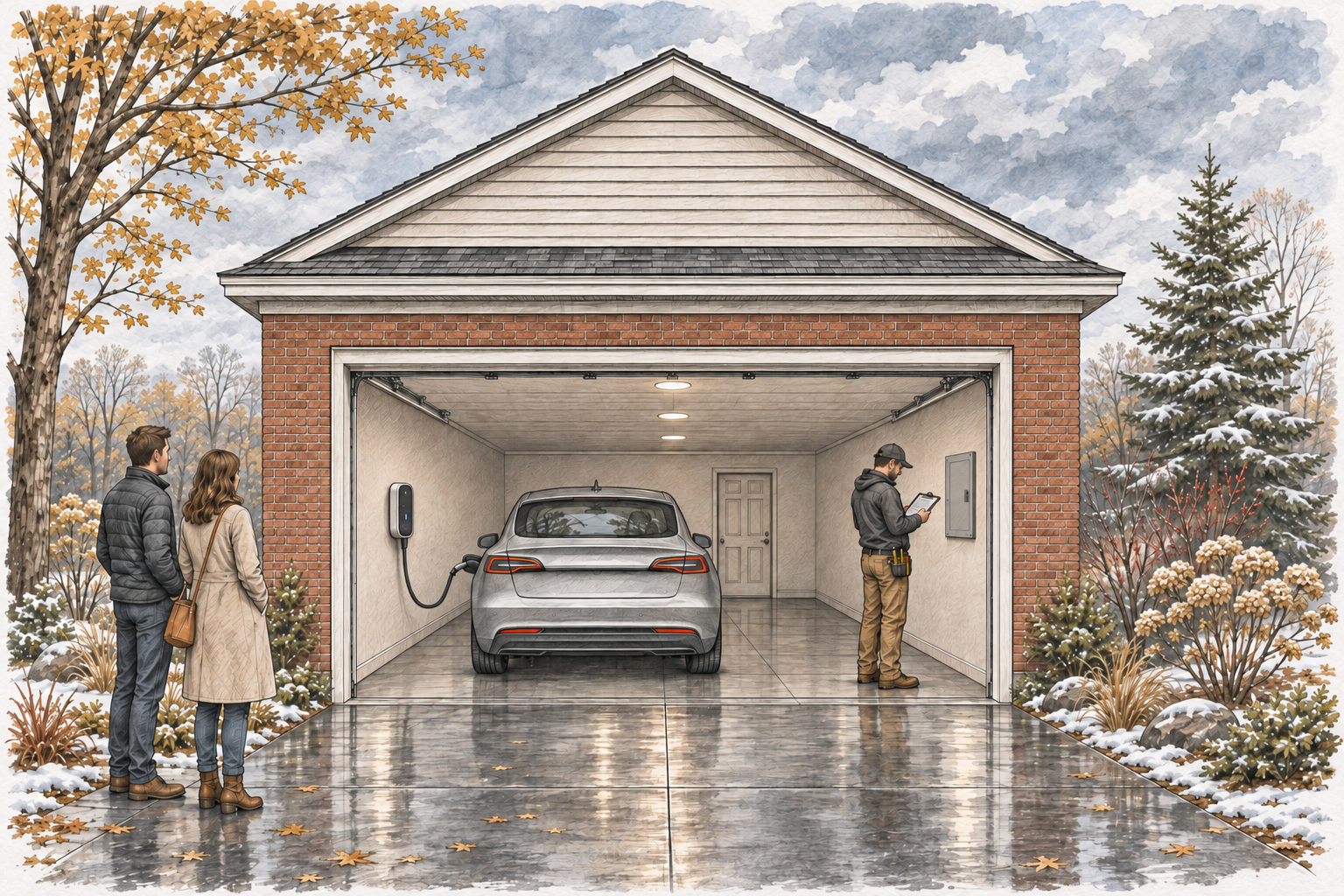
You open the garage door and see it: a sleek wall-mounted EV charger, neatly coiled cable, everything looking ready for a test drive and a smooth closing. Then the inspection turns up the question nobody can answer quickly: Is it on a properly sized, dedicated circuit, and was it permitted?
In West Michigan, that paper trail and electrical capacity story matters as much as the charger itself. This guide lays out what a charger can mean for resale, what Michigan requires on permits, how panel capacity becomes a negotiation point, and how to document the installation so it supports your sale instead of slowing it down.
Quick takeaways
- Plan on permits and inspection. Michigan’s baseline is clear: you generally need an electrical permit for installing, altering, or adding electrical conductors or equipment, and you must file with the appropriate enforcing agency for the property’s jurisdiction.
- Marketing matters. “EV charger” can mean a true Level 2 EVSE on a dedicated circuit, or it can mean a 240V receptacle. Clarity keeps inspection week calmer.
- Incentives can help, but details change. Consumers Energy’s residential programs can be meaningful for eligible customers, and the IRS home-charger credit depends on both timing and census tract eligibility.
Why EV charging now shows up in negotiations (even if the buyer is not an EV driver)
An EV charging setup is part utility upgrade and part “what exactly conveys?” question. Even for a buyer who does not plan to charge on day one, the presence of a charger can raise practical questions a buyer, inspector, or lender may want answered:
- Is it truly turnkey? A wall unit on the garage drywall is not proof of a dedicated circuit, correct breaker sizing, or sufficient service capacity.
- Is it tied to an app? Some chargers require Wi-Fi setup and an account, and a few features can be subscription-based. That is manageable, but it is one more handoff item at possession.
- Does it stay? A plug-in unit can feel like an “appliance,” while a hardwired wall connector reads like a fixture. If a seller plans to remove the unit, it should be excluded clearly up front so nobody is surprised later.
Level 1 vs. Level 2: listing language that stays honest
Most home conversations boil down to Level 1 (120V) vs. Level 2 (240V). The U.S. Department of Energy’s Alternative Fuels Data Center has a helpful, neutral overview of charging electric vehicles at home, including the idea that many drivers can meet daily needs with overnight Level 1, while Level 2 is the common upgrade for faster charging.
When you market a home, be specific. Instead of a generic “EV charger,” consider language like:
- “Hardwired Level 2 EVSE on dedicated circuit” (only if it is true and documented)
- “240V outlet in garage suitable for EV charging” (if it is a receptacle, not an EVSE)
- “EV-ready: conduit run / panel capacity planned” (if you have infrastructure but no unit)
The goal is simple: do not accidentally promise speed and safety you cannot prove.
Permits in Michigan: the baseline you should assume
Michigan’s LARA Construction Codes guidance is direct: you generally cannot equip a building with electrical conductors or equipment, or make an alteration, change, or addition, without first receiving a permit for that work. See LARA’s Electrical Permit Information page.
Two practical points matter for homeowners and sellers:
- The enforcing agency varies. LARA notes that electrical code enforcement may be conducted by the state, county, or local unit of government, and it points applicants to the Statewide Jurisdiction List so you file in the right place.
- Homeowners can pull permits in some cases. LARA explains that permits may be obtained by a licensed contractor, or by a homeowner performing electrical work in a single-family home and outbuildings owned and occupied (or to be occupied) by that homeowner. That is permission, not a recommendation. EV charging is a code-driven, continuous-load application, and it is worth getting right.
For code references, LARA’s Code Books page lists the 2023 National Electrical Code (NEC) as Michigan’s current electrical code, effective March 12, 2024.
Panel capacity and circuit sizing: where “charger included” can become real money
EV charging cost is not only the box on the wall. The scope can expand quickly depending on what your electrical system must do to support it.
Start with what you have: service size, breaker space, and future plans
Some West Michigan homes still run on 100-amp service, and that can be perfectly workable depending on what else in the home is electric. Add a Level 2 charger, then stack in an electric range, electric dryer, hot tub, or a future heat pump, and capacity planning starts to matter.
This is where a licensed electrician’s load calculation and a clean plan for breaker space pays for itself. For a transaction, it also helps you answer questions confidently when a buyer asks, “Will my setup work here?”
EV charging is treated as a continuous load
The code concept behind many EV charging conversations is that charging is a continuous load. DOE’s AFDC notes that EV charging infrastructure is considered a continuous load by the NEC, and points readers to NEC Article 625 for charging equipment guidance. See AFDC’s home charging guidance.
Plain-English translation: your circuit and equipment need to be sized and installed correctly so charging is reliable, safe, and less likely to create nuisance tripping or heat issues.
Charger output is not just marketing, it drives the electrical scope
In much of West Michigan, Consumers Energy’s programs provide a useful real-world marker for common residential installs. As of November 2, 2026, Consumers Energy’s PowerMIDrive Home Charger Installation Rebates page describes eligibility that includes a qualified Level 2 charger with a maximum output of 9.6 kW (50-amp circuit maximum and 40 amps of output maximum), and it cautions that exceeding that output may trigger additional electrical upgrade fees.
Seller positioning note: If you are installing a charger mainly to strengthen resale, “bigger” is not automatically “better.” A permitted, documented, right-sized install can be easier for a buyer to trust than a higher-output setup that implies a bigger electrical upgrade.
Equipment selection: what “safe and saleable” looks like
If you only remember one principle: choose equipment a future buyer and inspector can recognize as safety-certified.
- Buy safety-certified equipment. AFDC recommends purchasing safety-certified equipment, and notes that products certified under the ENERGY STAR label are tested by a nationally recognized testing laboratory.
- ENERGY STAR can be a practical filter. ENERGY STAR maintains an EV chargers category and product finder that can help narrow choices to certified models.
This is not about chasing a badge. It is about avoiding the inspection comment nobody enjoys: “Unlisted device. Recommend evaluation by a licensed electrician.”
Rebates and tax credits: what is real in West Michigan (and what you must verify)
Consumers Energy programs
If the home is served by Consumers Energy electric service, the PowerMIDrive pages are worth reading before you buy equipment.
- Installation rebate: Consumers Energy advertises up to $500 for installation of a qualified Level 2 charger, or up to $1,000 for income-qualified customers. See PowerMIDrive Home Charger Installation Rebates.
- Smart Charging Incentive: Consumers Energy describes earning $10 per month for up to 12 months (up to $120) by charging overnight, with enrollment into their Nighttime Savers rate as part of the program. See PowerMIDrive Smart Charging Incentive.
Utility reality check: Not every address in West Michigan is served by Consumers Energy. Some areas are served by municipal utilities or electric cooperatives. Before you assume a rebate applies, confirm who the electric utility is for that specific property and what that utility requires.
Federal tax credit (Section 30C): timing and census tracts matter
The IRS describes the Alternative Fuel Vehicle Refueling Property Credit for individuals and states that, for consumers who purchase and install an EV charger for a principal residence, the credit equals 30% of the cost up to $1,000 per charging port. The IRS also explains that the charger must be in an eligible census tract and provides different lookup steps based on whether the property was placed in service before January 1, 2025, or after January 1, 2025. See the IRS page: Alternative Fuel Vehicle Refueling Property Credit for Individuals.
Important timing note for this 2026 article: As of November 2, 2026, the IRS page states that the credit applies to eligible property placed in service beginning January 1, 2023, through June 30, 2026. If you are installing after June 30, 2026, verify whether the credit has been extended or changed before you budget for it. For any real situation, talk with a qualified tax professional and keep clean documentation.
The closing-safe checklist (seller and buyer)
For sellers: turn a charger into a trust signal
- Decide what conveys. If it is hardwired or mounted, many buyers will assume it stays. If you plan to remove it, exclude it clearly and make sure the remaining electrical is safely capped and covered.
- Gather the paper trail. Keep the permit, inspection approval (if you have it), electrician invoice, and equipment spec sheet. If you used a utility program, keep confirmation emails and the program terms in your file.
- Make the panel legible. A clearly labeled breaker (for example, “EV CHARGER”) reduces confusion during inspection and makes handoff at possession easier.
- Handle the app handoff. If the charger is networked, include basic reset and account-transfer instructions, or a link to the manufacturer’s guide.
For buyers: confirm what is installed, not what is implied
- Identify the charging type. Is it a true Level 2 EVSE, or a 240V outlet intended for charging?
- Ask for permit and electrician documentation. If the seller does not have it, that does not automatically mean it was unpermitted. It does mean you should verify with the appropriate enforcing agency and have a licensed electrician evaluate the setup before you assume capacity.
- Match the setup to your plan. One EV charging overnight is a different electrical conversation than two EVs, a long commute, or a future heat pump plan.
- For condos or attached housing, confirm authority. Parking assignment, common-element rules, and HOA approval can matter as much as the wiring.
A practical next step before you install (or write the offer)
If you are installing a Level 2 charger before listing, treat it like any value-building project: confirm the permitting path first, confirm panel capacity next, then choose safety-certified equipment and keep the documentation in one place.
If you are buying a home that already has charging, verify whether it is truly turnkey or the first chapter of an electrical upgrade plan. Either way, clear facts up front can prevent a small garage feature from becoming a closing-week scramble.