
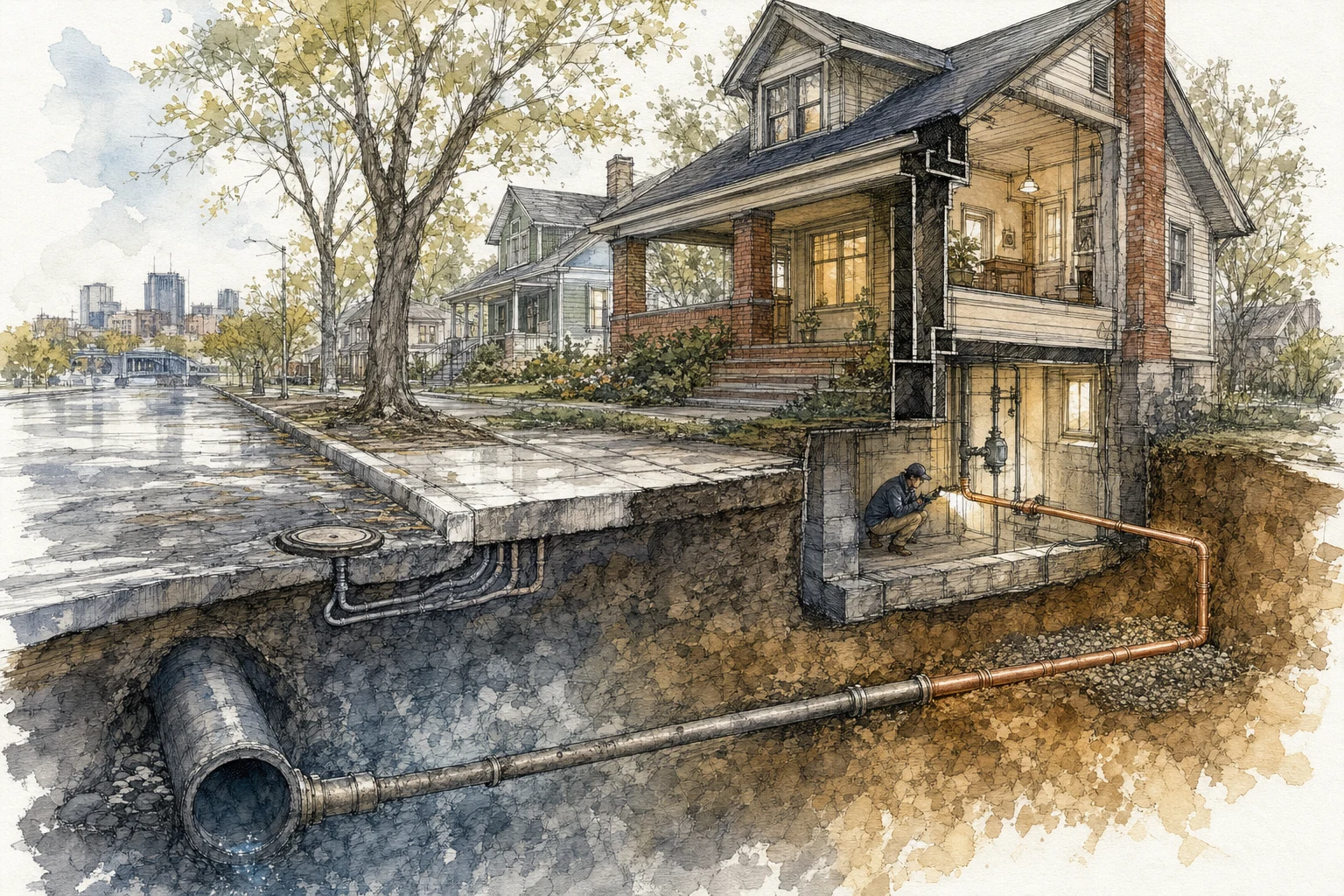
Conceptual cutaway illustration, not to scale and not an actual property or approved installation design. Pipe colors and connections are illustrative; replacement scope must be confirmed with the water utility.
You find the house. The porch is right, the layout works, the inspection items feel manageable. Then someone asks a question that sounds almost antique: “Is the water line lead?”
In older parts of Greater Grand Rapids, that is not a “fun fact” question. It’s a due diligence item that can change a buyer’s comfort level, a seller’s prep list, and the timeline of a deal. The tricky part is that you usually cannot see the whole service line without digging, and “unknown” on a map is not the same thing as “no.”
This guide is a practical, West Michigan specific playbook for 2026. You’ll learn how to check address-level tools in Grand Rapids and East Grand Rapids, what state and federal rules are pushing utilities toward full replacement, and how to write an offer (or list a home) in a way that keeps the transaction calm.
Quick takeaways
- In Michigan, service line material inventories are now the norm. EGLE required public water supplies to complete and submit a distribution system materials inventory (DSMI) by October 16, 2024, and that work is what powers many local lookup maps. (Michigan EGLE DSMI inventories overview)
- Grand Rapids has an address-level map, but “assumed lead” is a real category. If there are no confirming records that a line is non-lead and the home was built before 1950, the Grand Rapids map may treat the service line material as assumed lead. (City of Grand Rapids Lead Water Service Line Map instructions)
- The deal-safe move is to plan the replacement path early. Before you write an offer (or before you list), know who replaces what, whether replacement is scheduled soon, and what your negotiation “Plan B” is if timing does not line up. (City of Grand Rapids Lead Line Replacement Program)
What a lead service line is (and why real estate cares)
The service line is the pipe that connects the water main in the street to your home’s plumbing. In many cities it is effectively two segments: a “public side” (utility side) and a “private side” (property side). Lead can also exist inside the home (older solder, fixtures, or plumbing), but lead service lines are typically the most significant source when they are present. (U.S. EPA: Lead in Drinking Water)
Health guidance is blunt for a reason. The EPA’s maximum contaminant level goal (MCLG) for lead is zero, and the EPA notes there is no safe level of exposure. (U.S. EPA: Lead in Drinking Water) The CDC similarly states that no safe blood lead level in children has been identified. (CDC: No safe blood lead level in children)
Translate that into real estate terms and you get three realities:
- Buyers ask earlier, sometimes before they even schedule a showing.
- Sellers get asked for documentation, not just reassurance.
- Timing matters, because replacement is coordinated with a utility or city program, not just your favorite contractor.
The 2026 rule environment: why maps and notices have improved
Michigan and federal rules both push utilities toward inventory and replacement.
Michigan: inventory deadlines and full replacement expectations
Michigan’s revised Lead and Copper Rule requires utilities to build and maintain a DSMI and sets stronger replacement expectations. EGLE summarizes that a final DSMI was due October 16, 2024 and that inventories are updated on a cycle. (EGLE: Lead and Copper Rule Revision Summary)
That same EGLE summary also states that:
- Partial lead service line replacement is no longer allowed except for emergency repair situations.
- Systems with lead service lines must replace them at an average rate of 5% per year so replacement is completed within 20 years (or under an approved alternate schedule).
- The full lead service line must be replaced at the water supply’s expense, regardless of ownership, under the Michigan rule framework described in the summary.
(EGLE: Lead and Copper Rule Revision Summary)
Federal: LCRI is coming, and inventories are already required
At the federal level, the EPA finalized the Lead and Copper Rule Improvements (LCRI) and describes it as requiring systems to identify and replace lead pipes within 10 years. (U.S. EPA: Lead and Copper Rule Improvements overview)
For real estate decisions in 2026, two dates are worth keeping straight:
- October 16, 2024: service line inventory and service line material notification requirements took effect under the federal timeline retained from LCRR. (U.S. EPA fact sheet: LCRR requirements retained and compliance dates)
- November 1, 2027: the EPA’s fact sheet identifies this as the LCRI compliance date. (U.S. EPA fact sheet: LCRI compliance date)
These are system-level requirements, not a promise that an individual property will be replaced by a particular transaction date. Confirm the utility’s current schedule and any applicable rule exceptions. The practical point: in 2026, you should expect your local water system to have an inventory story, and often a public-facing lookup tool. (U.S. EPA: Final LCRI fact sheet for the general public (Oct 2024)) But you should also expect “unknown” and “assumed” categories to persist until lines are physically verified or replaced.
How to check a property in Grand Rapids in about 10 minutes
If you are buying or selling in the City of Grand Rapids, start with the city’s map.
- Open the map and search the address. The City’s instructions tell you to use the magnifying glass and click the dot to see service line material information. (Grand Rapids Lead Water Service Line Map)
- Read the “assumed lead” logic carefully. The City notes that if there are no records confirming the line is non-lead and the property was built before 1950, the material may be assumed lead. (Grand Rapids map instructions)
- Check the replacement timing indicator. The City notes that if the circle appears inside a blue square, the property is scheduled for replacement within the next 24 months from the map’s update date, and that the timeline can change. (Grand Rapids map instructions)
- Cross-check with the program page for how replacement is handled. Grand Rapids’ program FAQ explains how owners are contacted, what replacement typically involves (including basement access), and what is expected after replacement such as flushing. (Grand Rapids Lead Line Replacement Program)
Deal note: In Grand Rapids, the City states it plans to replace all lead service lines at no cost to the property owner when scheduled, but also describes an owner-initiated option where the City replaces the public side at no cost and the owner pays for the private side, with a Ten-Pay financing option mentioned. Read the current City guidance and confirm details directly with the City before you build it into a contract strategy. (Grand Rapids Lead Line Replacement Program FAQ)
East Grand Rapids (and “nearby”): expect a map, but treat it as a starting point
Outside the City of Grand Rapids, the right first step is usually your local DPW or water utility site. For example, the City of East Grand Rapids states it created a service line inventory map and notes it may not always be current because it is updated periodically. (City of East Grand Rapids: Water/Sewer Systems)
That “not always current” line is not a knock on the City. It’s a reminder that inventory work is ongoing, and real estate decisions happen on tight timelines. So use the map, then verify with the utility if the result will affect your offer terms.
Offer-stage strategy: how lead service line uncertainty becomes a solvable problem
There are three different situations that deserve three different negotiation approaches.
1) The line is confirmed non-lead
Document it. Save the map screenshot or utility confirmation email in your transaction file. If you’re selling, consider attaching it in your listing prep packet so the buyer does not have to go hunting mid-negotiation.
2) The line is lead, and replacement is scheduled soon
This is often the cleanest path. The buyer’s concern is real, but the “solution” is already in motion. In Grand Rapids, the City suggests owners can check whether replacement is scheduled within the next 24 months via the map and that owners are contacted 6 to 12 months in advance for scheduled work. (Grand Rapids Lead Line Replacement Program; Grand Rapids map instructions)
In this scenario, negotiation usually centers on comfort and communication, not massive deal structure: confirming schedule expectations, understanding access requirements, and agreeing on what happens if timing shifts.
3) The line is lead (or “assumed lead”), and replacement is not scheduled in your window
This is where deals get noisy. Not because replacement is impossible, but because there are multiple moving parts: who pays, who coordinates, and when the work can happen.
Common deal-safe options to discuss with your agent and closing professionals include:
- Seller coordinates replacement prior to closing, if the utility’s process and schedule realistically allow it.
- Price or credit negotiation, where the buyer takes on coordination after closing.
- Escrow holdback (when allowed by lender and closing parties), designed to keep the closing date intact while reserving funds for a defined scope of work.
The right choice depends on the property, the utility’s program rules, and the buyer’s tolerance for post-closing projects. There’s no universal “best” answer, but there is a universal best practice: don’t wait until the final week before closing to start the conversation.
If you’re selling: the “pre-list” move that prevents a buyer from rewriting your timeline
Sellers of older homes in Grand Rapids, East Grand Rapids, and other established West Michigan neighborhoods can usually lower friction with three steps:
- Run the map lookup before photos. If the property shows lead, assumed lead, or unknown, decide what you want your plan to be before a buyer asks.
- Collect any notices or prior documentation. Michigan and federal frameworks include customer notification requirements tied to service line materials and inventories. Having your paperwork organized helps your listing feel straightforward. (EGLE summary; EPA compliance dates fact sheet)
- Be precise in disclosures and responses. “Unknown” is a valid answer when it’s true. The mistake is treating “unknown” as “probably fine” without doing any verification that a buyer can also do.
After replacement: don’t skip the boring part
Replacement can temporarily disturb lead particles. Follow the utility’s full written post-replacement instructions, not a shorthand timer alone. Grand Rapids instructs occupants to remove aerators, open cold-water taps from the lowest level upward, and run water for at least 30 minutes after the last tap is opened; follow its shutdown and aerator-cleaning steps and call 311 afterward about the credit. Ask the utility about filtration and testing appropriate to your home. (Grand Rapids Lead Line Replacement Program)
If you’re buying a home where replacement just happened, make sure you understand what the utility expects the occupant to do immediately after the work. If you’re selling, it’s worth documenting that you followed the utility’s post-replacement steps.
A closing-safe checklist (buyers and sellers)
- Identify the governing utility. City, township, or authority. Then find its service line inventory tool or contact point.
- Run the address in the map. Save the result to the transaction file, especially if it shows assumed lead or unknown.
- Ask the right question early: “Is replacement scheduled in the next 24 months?” In Grand Rapids, the map is designed to answer that question, with timing caveats. (Grand Rapids map instructions)
- Decide your plan before inspection day. Replacement coordination, credit, or escrow strategy should not be invented in a panic after the report is delivered.
- Confirm post-replacement steps if the work occurred recently. Flushing guidance and any written confirmation matter for peace of mind and documentation. (Grand Rapids Lead Line Replacement Program)
If you’re buying an older home in Grand Rapids or nearby and want a pre-offer plan that accounts for the city’s schedule, the map categories (including assumed lead), and the cleanest negotiation path for your timeline, I’m happy to help you build that strategy before you’re under the gun.