
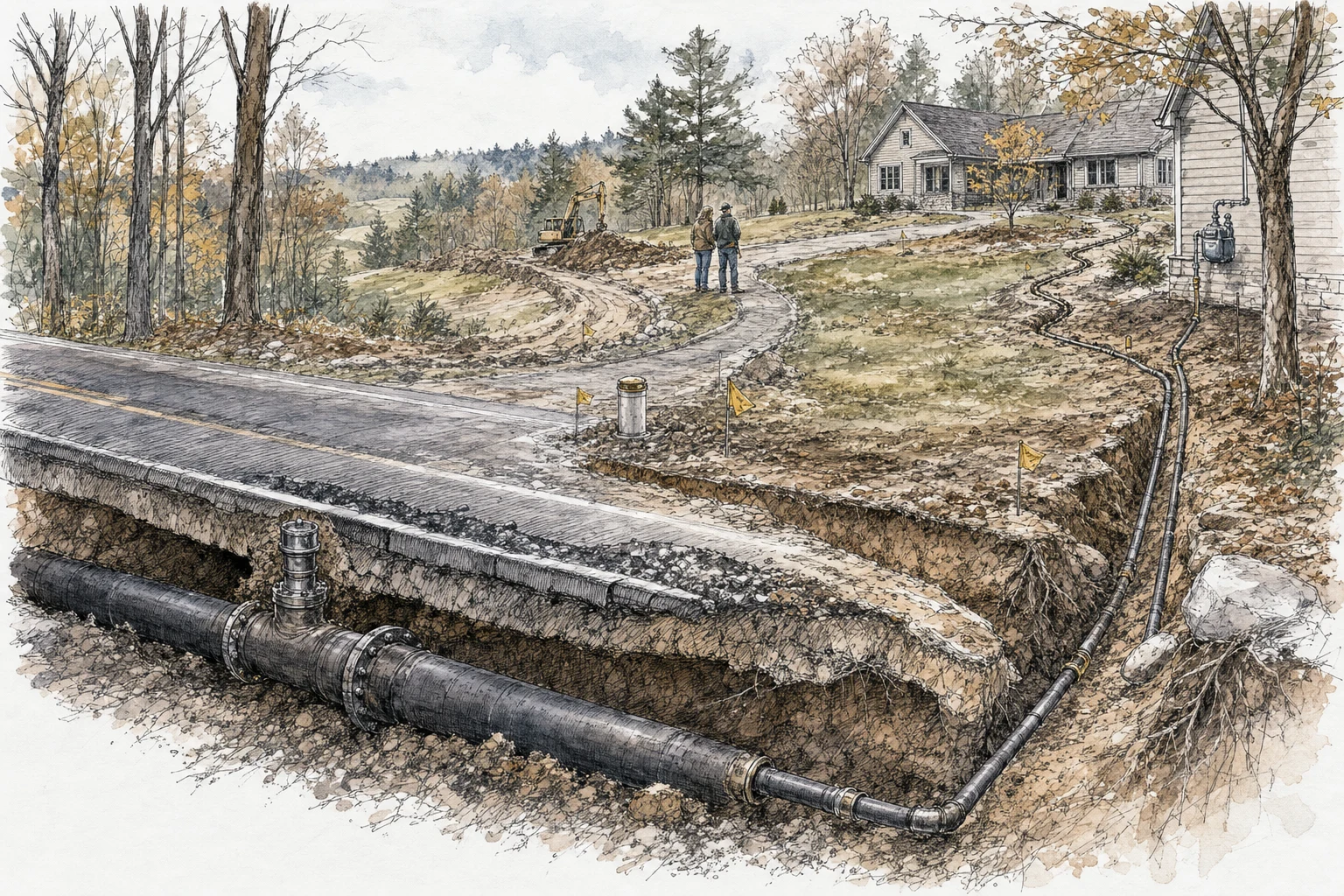
Conceptual pen-and-ink watercolor illustration, not to scale. Pipe sizes, routes, connections, and excavation shown are illustrative only; not an installation plan or a representation of a specific property.
In West Michigan listings, “natural gas available” can mean three very different things: gas is already connected to the house, gas main is nearby but you still need a service line and meter, or gas is a multi-step extension project that comes with fees, paperwork, and a timeline that does not care about your closing date.
This matters because fuel type is not just a comfort preference. It can change operating cost assumptions, affect what a buyer is willing to pay, and create very real friction during inspections, appraisal, and lender conditions if the plan is “we’ll get gas hooked up later.”
Quick takeaways
- “Gas at the road” is not a promise. Before you write an offer, confirm the utility provider and whether there is an existing main, an extension project, or a long service line across private property.
- Watch for ongoing surcharges tied to past extension projects. In Consumers Energy’s rules, a Fixed Monthly Surcharge can follow the property and can be billed to a subsequent customer.
- Do not skip the safety and logistics basics. Any trenching, boring, fence, deck, or landscape work near utilities should start with a MISS DIG 811 ticket and a realistic install schedule.
First, figure out who the gas utility actually is
West Michigan is not a single-utility world. Even within the same county, the natural gas provider can change by municipality or township, and some properties are simply outside an economical extension area.
A clean starting point is the Michigan Public Service Commission’s Natural Gas & Pipelines page, which links to a provider search and service area map you can use by city or township.
In parts of Allegan and Ottawa Counties, for example, SEMCO Energy Gas lists Western Michigan coverage directly on its Residential Customer Application page. That is a good reminder not to assume that “everyone around Grand Rapids is on Consumers.”
Seller-side tip
If you are listing and your marketing mentions natural gas availability, build your proof package now: utility name, a recent bill if service exists, and any documentation from past extensions or surcharges. It is much easier to control the narrative up front than to answer panicked questions five days before closing.
What “available” can mean: main, service line, or full extension
Here is the plain-English breakdown buyers and sellers should align on:
- Gas is connected now: there is a meter, an active account, and gas appliances (or at least a working service) at the home.
- Gas main exists nearby, but no connection: you may still need a new service line, meter set, connection fee, permits for interior work, and scheduling.
- No main where you need it: you are talking about a main extension or a project that can involve easements, contributions, and sometimes a monthly surcharge program.
Those are three different budgets and three different timelines. They should be treated differently in negotiations.
The West Michigan closing trap: CAP and “Fixed Monthly Surcharge” surprises
Consumers Energy addresses line-extension economics through its Customer Attachment Program and related tariff rules. In the company’s Michigan Public Service Commission-approved gas rate book, Consumers describes how a Fixed Monthly Surcharge can be used to recover a revenue deficiency for a Customer Attachment Project, and it states that a subsequent customer requesting gas service at the property address, once notified by the company, shall be liable for the surcharge. It also states that failure by sellers, agents, lessors, or other non-company parties to notify a customer does not relieve the customer’s obligation. (See the Consumers Energy gas rate book, Rule C8.)
Consumers also publishes a Customer Attachment Program form for financed service on an existing main. That form is unusually direct: it instructs the property owner to disclose any monthly CAP surcharge balance to a real estate agent and buyers, and notes that new buyers will be responsible for remaining payments unless the balance is paid off. (See Consumers Energy Form 0066, Customer Attachment Program.)
How this shows up in real transactions
Not every home has a surcharge. But when one exists, it can create immediate friction if the buyer’s plan was to “switch to gas later,” or if the buyer is budgeting tightly and the monthly utility payment is part of underwriting.
Practical way to detect it: ask for a recent gas bill if the home already has service and look for line items that are not just usage and delivery. If the home does not have gas service yet, ask the utility what costs or surcharges would apply to start new service at that address.
Long driveways and “Excessive Service Line” fees
Rural and semi-rural West Michigan homes often have the same pattern: the road looks normal, but the house sits far back on the parcel. That distance can matter.
In the same Consumers rate book section, the company describes an Excessive Service Line Fee assessed when a customer’s service line requirement exceeds a service line limit, with the limit calculated annually. Translation: a long service line across private property from the road to the house can change the project economics. (See the Consumers Energy gas rate book.)
Treat “long driveway plus ‘gas at the street’” as a yellow flag until the utility confirms in writing what the install scope and customer costs would be. That confirmation is what turns marketing language into a decision you can price.
Fees you can actually point to (and why you should still verify)
Utilities change fees over time, so you never want to quote numbers from memory. But it is helpful to know what is commonly on the menu.
In Consumers Energy’s tariff, the Connection Fee is shown as $200 per meter (with a separate provision for certain multiple-meter installs), effective for service rendered on and after October 1, 2022. (See the Consumers Energy gas rate book.)
Even if your property is outside Consumers’ territory, that is still a useful mental model: a “simple” connection can have standardized fees plus project-specific contributions. Always verify with the utility serving the property.
Safety and logistics: MISS DIG is not optional
If your plan involves trenching a new gas line, replacing a service, installing a pool, setting deck footings, or even just banging in fence posts, you are in MISS DIG territory.
Contact MISS DIG 811 at least three business days before excavation. Waiting alone does not clear a site: on or after the ticket’s Work Legal Start Date, check Positive Response and resolve incomplete responses or missing, incorrect, or damaged markings with MISS DIG before digging. A normal ticket requires work to start within 14 days and finish within 21 days of that legal start date; obtain a new ticket if those limits are exceeded. Utility marks show approximate location, not depth. Privately owned lines, such as a line to a detached building or grill, require a separate private locator. Follow the ticket instructions and safe-excavation requirements rather than treating a marked site as unrestricted permission to dig. See the MISS DIG 811 homeowner FAQ.
On its homeowner guidance, MISS DIG also notes that if a homeowner hires a contractor/excavator, it is the contractor’s responsibility to contact MISS DIG for a locate request under Public Act 174. (See MISS DIG digging safely guidance.)
For a more formal compliance angle, MIOSHA’s fact sheet highlights that employers must comply with both construction safety standards and the MISS DIG Underground Facility Damage Prevention and Safety Act (Public Act 174 of 2013). (See MIOSHA MISS DIG 811 fact sheet.)
Offer-stage checklist: how to keep “gas available” from becoming your problem
If you are buying
- Confirm the provider using the MPSC natural gas provider resources and the seller’s current utility bills.
- Ask what exists today: Is there a meter? Active account? Which appliances are gas?
- If not connected, ask the utility whether service is on an existing main or requires an extension project, and what customer contributions or surcharges could apply.
- Measure the problem: approximate distance from road to home, and note obstacles (private roads, creeks, mature landscaping, hardscapes) that could complicate a run.
- Do not assume conversion is “simple”: appliance conversion, venting, permits, and contractor scheduling all matter. Treat it as a scoped project, not a weekend errand.
If you are selling
- Collect documentation: most recent gas bill, any CAP paperwork, and any evidence a surcharge is paid off (if applicable).
- Decide how to market it: “gas connected” is stronger than “available,” but only say what you can prove.
- Pre-answer the buyer’s lender/appraiser questions: if heat source is changing, make sure listing remarks and disclosures do not overpromise what is not installed.
A negotiation note (not legal advice)
If a buyer is making an offer assuming a fuel switch, the cleanest approach is usually to treat natural gas availability as a due diligence item with a decision deadline, not a vague hope. That can mean verifying provider, verifying project type (main vs extension), and getting written confirmation of charges and timeline before the inspection window closes. The right structure depends on the property and terms, so loop in your agent and, when appropriate, your attorney.
When to get a second set of eyes
If the home sits far off the road, if the listing language is fuzzy, or if there is any mention of extension projects or surcharges, it is worth slowing down. These are exactly the details that look boring until they change your monthly cost or your closing date.
If you want help building a simple “proof file” for a listing (bill, provider confirmation, surcharge status) or a buyer-side verification plan before you write an offer, Thomas can help you structure the questions and deadlines so fuel type does not become a last-minute surprise.