
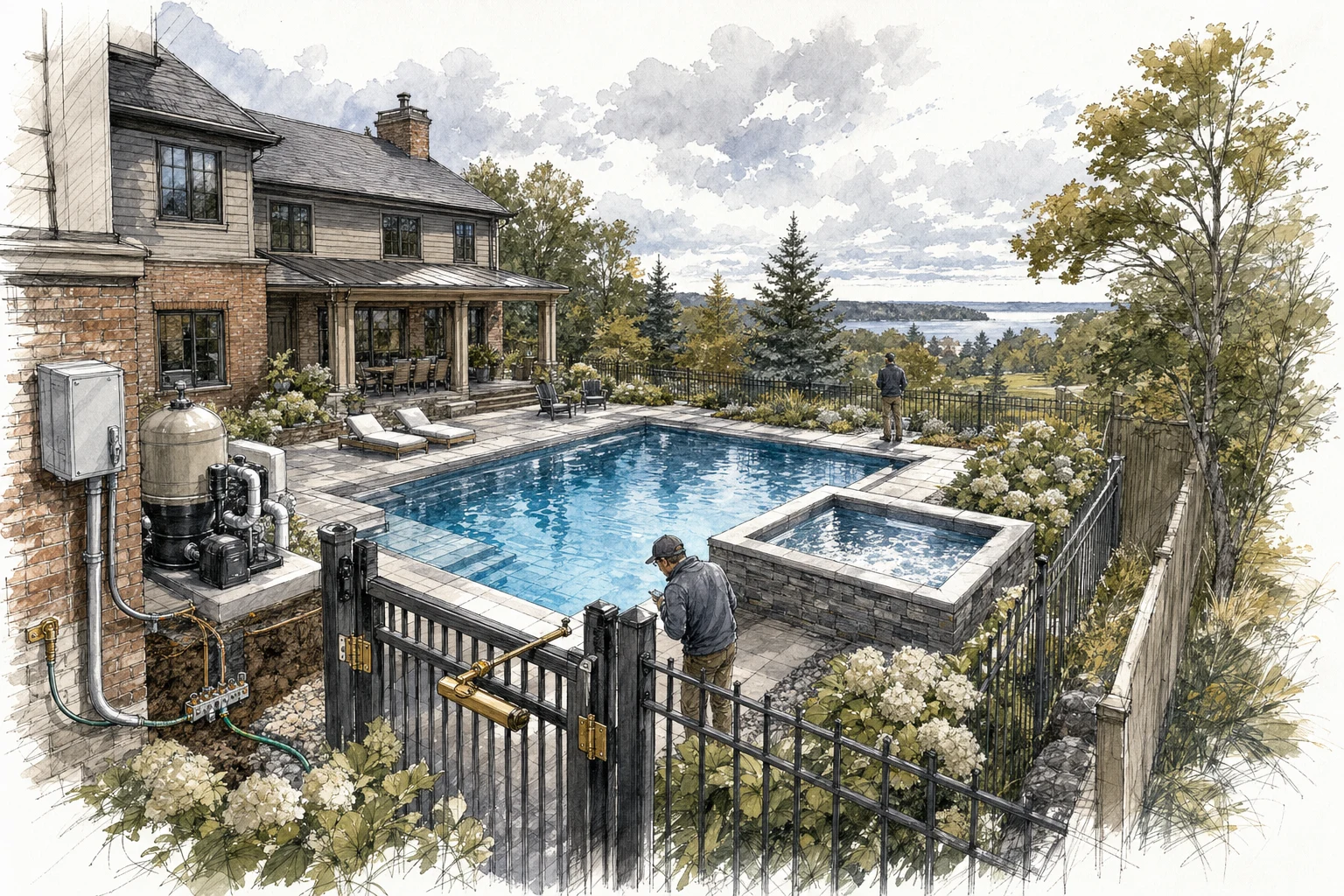
Conceptual pen-and-ink watercolor illustration, not a specific property or code-compliance diagram. Fence, gate, equipment, and electrical details are illustrative; actual installations require professional design and local inspection.
In July, a pool is a lifestyle purchase. In October, it is paperwork.
In West Michigan, pools, hot tubs, and spas have a way of turning an otherwise clean deal into a “wait, do we have permits for that?” moment. Not because anyone is trying to hide anything, but because the rules are split between zoning (where it can go), building (how it is built), and electrical (how nobody gets hurt). Miss one piece, and you can end up negotiating under deadline with a buyer, an appraiser, and an insurer all asking different questions.
This guide is a practical reality check: what typically triggers permits, what fence and barrier requirements tend to look like around Greater Grand Rapids and along the lakeshore, and a closing-safe checklist you can use before you buy, list, or install.
Quick takeaways
- Check permits and barriers separately: Holland requires a building permit for a pool or tub capable of holding 24 inches or more of water. Barrier rules have their own exceptions; an approved safety cover or qualifying above-ground design does not automatically waive a building permit.
- Zoning is not an afterthought: setbacks, corner-lot rules, and easements can force a redesign, or kill the plan entirely, even when the pool itself is code-compliant.
- Electrical is where deals get nervous: bonding, GFCI protection, and an inspected, permitted installation is the difference between “nice backyard” and “future liability.”
Start with the jurisdiction: city, village, or township rules can diverge fast
West Michigan is a patchwork of jurisdictions. “Kent County” is not a set of pool rules. It is a set of addresses with different building departments and zoning ordinances.
Even within the Greater Grand Rapids area, requirements vary. The City of Grand Rapids, for example, directs homeowners to start with a pool permit process through its Development Center, and specifically flags that a building permit is part of the deal. (City of Grand Rapids pool permit page)
On the lakeshore, the City of Holland publishes pool and hot tub permitting and barrier guidance for residential properties. (City of Holland pool and hot tub information)
Decision point: Before you price a home as “comes with a pool” (or write an offer assuming you can add one), identify the exact municipality and pull the relevant checklist or permit page. That one step prevents most last-minute surprises.
The “24-inch rule” (and why inflatable does not always mean exempt)
A water-depth threshold is a useful warning to check local requirements, not a universal exemption rule. Holland’s pool and hot tub permit guide requires a building permit for a pool or tub capable of holding 24 inches or more of water. Confirm the exact municipality’s treatment of your proposed installation before buying or setting it up.
This matters because homeowners often assume:
- “It’s seasonal, so it doesn’t count.”
- “It’s above-ground, so it doesn’t count.”
- “It’s a hot tub, not a pool.”
Do not confuse a barrier exception with a permit exemption. Holland lists enclosure alternatives for certain approved safety covers and qualifying above-ground pools with controlled ladder access. Its separate building-permit trigger still needs to be checked. Have the building official confirm which construction, enclosure, and electrical approvals apply. (Holland permit and enclosure guide)
Closing reality: Even if something is arguably exempt today, buyers, insurers, and inspectors may think in categories: “water, wiring, barrier, liability.” If the installation looks permanent, it will get permanent questions.
Zoning: where the pool can go is often harder than how to build it
In real-world transactions, the most painful pool surprises are not about the shell or the liner. They are about placement.
Grand Rapids requires review of pool placement under its zoning rules, including the applicable yard and property-line restrictions. Confirm the current rule for the parcel and include the pool, deck, equipment, and easements in the site plan; do not rely on an old ordinance PDF or a generic setback number. (Grand Rapids pool permit resources)
Common zoning and site constraints across West Michigan include:
- Setbacks from side and rear lot lines (and different treatment for corner lots).
- Utility easements along lot lines where you may not be allowed to build, excavate, or place permanent structures.
- Stormwater features like swales and drainage easements, where a pool can interfere with engineered flow paths.
- Accessory structures that “follow the pool,” like a new deck, equipment pad, or privacy fence, each potentially requiring separate review.
Practical tip: If you are buying with plans to add a pool, treat it like a mini land-use project. Ask for the survey and any recorded easements early. If there is no recent survey, budget time for one before you get emotionally attached to a layout.
Before you dig: MISS DIG 811 is not optional
Before pool excavation, the person doing the digging must contact MISS DIG 811 at least three business days in advance. On or after the Work Legal Start Date, check Positive Response and resolve incomplete responses or missing markings before digging. Privately owned lines need a separate private locator; utility marks do not establish line depth. Follow the ticket and safe-excavation instructions. (MISS DIG 811 homeowner FAQ)
Fences and barriers: the rule is local, but the pattern is predictable
Barrier requirements are one of the most consistent features across jurisdictions, but the details vary. A useful example from the City of Holland’s ordinance language is a minimum 48-inch barrier height, self-closing and self-latching gates, and additional specifics about latch placement. (City of Holland code, pool enclosure standards)
East Grand Rapids’ code includes an enclosure requirement for outdoor in-ground pools, including a 4-foot minimum height, along with provisions for temporary fencing during construction. (East Grand Rapids pool fencing code; East Grand Rapids temporary construction fence requirement)
Ask the local building department which adopted code provisions and application checklist govern the proposed work. Do not assume a newer model-code edition is already in force in Michigan. LARA’s current guidance says the 2015 residential standards remain in effect while the court order concerning the proposed 2021 update remains in place. (Michigan LARA code-update status)
Transaction mindset: A sale does not automatically mean every existing enclosure must be rebuilt to new-installation standards. Holland’s maintenance code permits enclosures to be maintained as originally installed, subject to its safety and repair rules; changes and replacement can trigger additional requirements. Ask the building official how the rules apply to the actual fence and its alteration history, and separately check the buyer’s insurer requirements. (Holland Code § 14-4.8(j))
Electrical: permits, bonding, and why buyers care even when the pool works
Pools and water features are a special category for electrical safety. Michigan’s state guidance on permits is blunt: you generally cannot install or alter electrical conductors or equipment without first receiving a permit for the work. (Michigan LARA electrical permit information)
At a practical level, buyers (and their inspectors) may focus on a few questions:
- Was the electrical work permitted and inspected? (Especially any new circuits, disconnects, and underground runs.)
- Is required bonding present? Bonding is about equalizing electrical potential between components so you do not become the path to ground.
- Is GFCI protection in place where required? (This often includes receptacles, pumps, lighting, and nearby outlets.)
Closing-safe advice (without getting into code interpretation): Keep the paperwork. If you cannot produce an electrical permit or final, expect the buyer to ask for a licensed electrician to evaluate and, if needed, bring the system into compliance before closing.
Buyers: a due diligence checklist for pools and hot tubs
- Ask for permits and finals for the pool itself, the electrical, any gas heater line, and any deck built with the project.
- Confirm the barrier situation: fence height, gate function, latch condition, and whether any doors from the house open directly into the pool area (municipal rules vary on what is allowed and how it is protected).
- Check zoning constraints you are inheriting: if the pool or fence is nonconforming, future repair or replacement can be more complicated than you expect.
- Get clear on what stays: safety cover, removable ladder, equipment, robot, chemicals, winter cover anchors, and any maintenance contract are all negotiable and should be written down.
- Insurance reality check: before you remove contingencies, verify with your insurer what they require for pools, diving boards, slides, and fencing. Do not assume the seller’s carrier standards match yours.
Sellers: pre-listing steps that prevent “permit panic” at inspection
- Pull your permit history now, not after the buyer asks. If something was done by a prior owner, you want time to figure out what can be documented.
- Test the barrier like a buyer will: gates that do not self-close, latches that do not catch, or sagging sections become leverage points in negotiation.
- Organize pool documentation: install contract (if available), equipment manuals, service records, winterization receipts, and any resurfacing or liner history.
- Be careful with “included value” in pricing: a pool can help marketability, but buyers also underwrite risk. A clean, permitted, inspected installation can support value better than a flashy install with missing paperwork.
If it’s not a private backyard pool: EGLE may be involved
Most homeowners reading this are dealing with residential rules. But if the property includes a neighborhood pool, club pool, or other non-private installation, Michigan EGLE regulates public swimming pool construction permitting and makes clear that an EGLE permit does not replace local permits. (EGLE public swimming pool construction permits)
For buyers evaluating condos, HOAs, or private clubs tied to a property, that distinction matters. Different rules, different compliance trails, different liabilities.
A simple way to keep the deal on track
If you are buying a home with a pool or hot tub, or considering adding one before you sell, treat it like a mini project with three files: zoning, building, and electrical. If you can document all three, negotiations stay calm.
If you want a second set of eyes on how a pool, spa, or enclosure is likely to be viewed in inspection and underwriting, I can help you build a clean plan: what to pull from the municipality, what to fix before listing, and what to negotiate so the closing stays boring in the best way.