
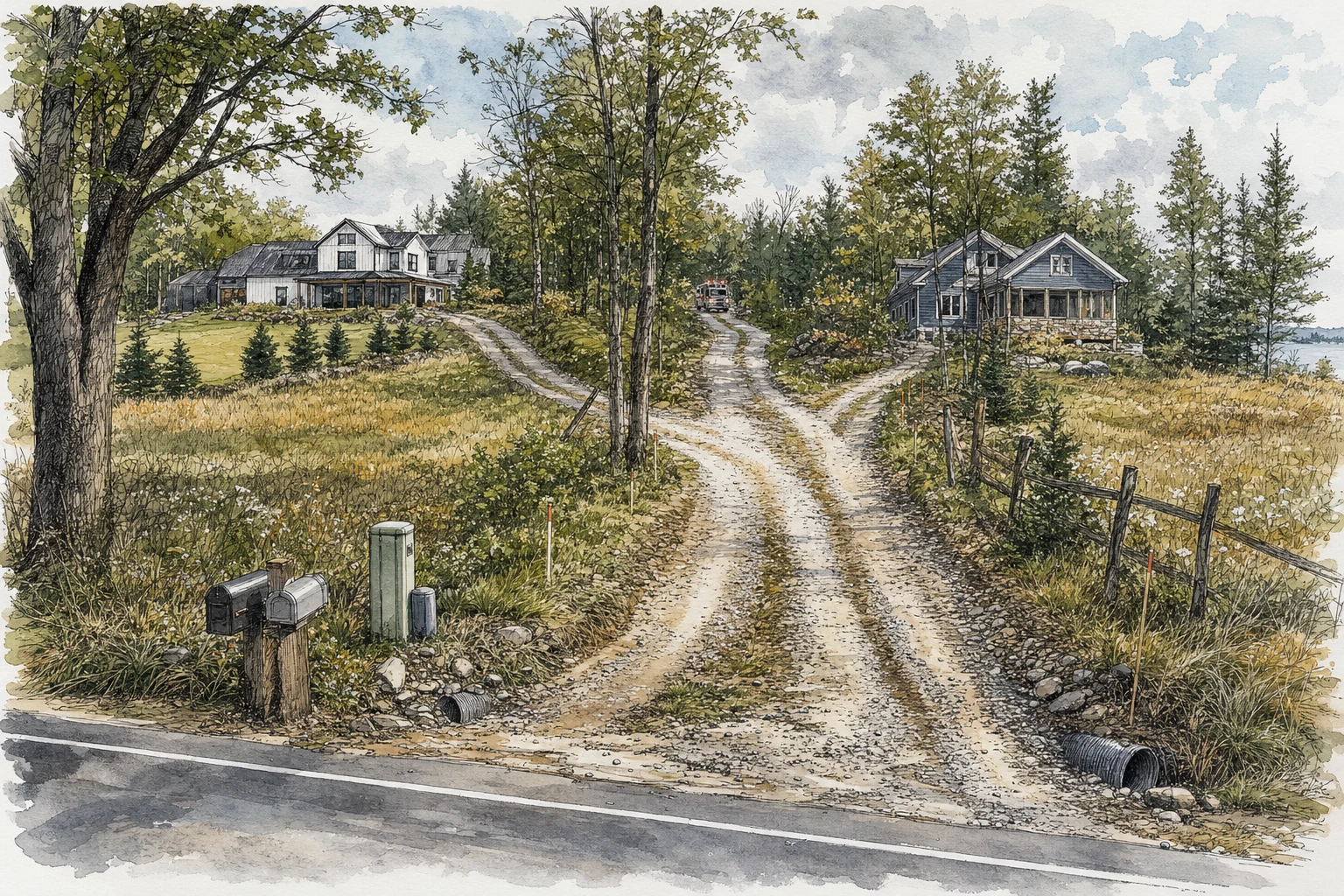
The house is perfect. The price is fair. The inspection went fine. Then your lender asks a question that sounds harmless until it isn’t: “Is the road public and maintained, or private?”
In West Michigan, “private road” can mean anything from a neat little platted lane in a newer development to a long gravel run across somebody else’s parcel that has been “fine for 30 years.” The difference matters because it changes three things that can make or break a closing: legal access, loan approval, and who pays when the road turns into a springtime mess.
Quick takeaways
- Private-road status is a financing issue and a resale issue, not just a “gravel vs. pavement” preference.
- Recorded, permanent access rights (easements or recorded roadway rights) are the backbone of a deal. “Everybody’s always used it” is not the same thing.
- Rules vary by township. Fire access, turnaround requirements, and private-road standards can be stricter than buyers expect, especially when additional homes are added.
What “private road” actually means in West Michigan
Buyers hear “private road” and picture maintenance: plowing, grading, potholes. That is part of it. But in real estate, the bigger question is usually: Do you have clearly documented, permanent, insurable access from the home to a public road?
Even Michigan law uses “private road” differently depending on context. For example, the Michigan Vehicle Code defines a “private road” and a “private driveway” for traffic-law purposes, and the definition emphasizes whether the road is open to public travel (Michigan Legislature, MCL 257.44 excerpt).
On the ground, you will typically run into one of these setups:
- A platted private street serving multiple homes, sometimes with a road association or HOA-like structure.
- A shared driveway serving two (or a few) homes.
- An access easement over a neighbor’s land, sometimes wide and obvious, sometimes not.
The three layers that make or break a private-road deal
1) Legal access: recorded and durable
From a closing standpoint, legal access is about whether the right to use the road is recorded and runs with the land, not with a particular owner’s goodwill.
Michigan lawyers and title professionals commonly look to established principles around easements. The Michigan Land Title Standards (6th Edition through Supplement No. 8) includes standards and examples covering easements created by grant or reservation, and also easements implied by necessity when a parcel would otherwise be landlocked.
Important practical point: an implied easement might be a real legal concept, but uncertainty is poison for financing. When access is not clearly documented, lenders and title insurers can require additional work (and time), or they can decline the file altogether.
2) Financeable access: what loan programs commonly want to see
Loan requirements change, and lenders can add “overlays,” but the published baseline guidance is still useful for setting expectations:
- FHA (HUD Handbook 4000.1): HUD states the mortgagee must confirm safe pedestrian access and adequate vehicular access from a public or private street, and that private streets (including shared driveways) must be protected by permanent recorded easements, ownership interest, or be owned and maintained by an HOA. HUD also states private streets and shared driveways do not require a joint maintenance agreement (HUD, Single Family Housing Policy Handbook 4000.1).
- VA loans: VA guidance has emphasized recorded, permanent access (easement or right-of-way) to a public road. VA also issued guidance stating that an HOA maintenance agreement or joint maintenance agreement is no longer required in these situations, while confirming that recorded access is still required (VA Circular 26-22-17).
- Conventional (Fannie Mae): Fannie Mae’s Selling Guide discusses private streets and maintenance. It notes that if a property is in a state with statutory provisions defining maintenance responsibilities, a separate agreement may not be required. It also discusses lender indemnification exposure related to access and the condition of the street (Fannie Mae Selling Guide, B4-1.3-04 (Site section)).
Translation: even when a handbook says a specific document is “not required,” you still need recorded access, and you still need a road situation the appraiser and underwriter can get comfortable with. If the road is barely passable, seasonally impassable, or legally murky, you can still hit delays.
3) Practical access: emergency vehicles, snow, and turnarounds
Townships can regulate private roads and shared driveways, especially when new private streets are proposed or when lots are created. They also tend to care a lot about emergency access. That is not bureaucratic fussiness. It is response time, turning radius, and whether a fire truck can reach the structure.
Here are a few local examples that show how real these standards can be:
- Caledonia Charter Township: The Township’s fire safety guidance references clearance expectations, including private streets at 30 feet wide by 14 feet vertical clearance and driveways at 20 feet wide by 14 feet vertical clearance (Caledonia Charter Township Fire Safety Tips).
- Cannon Township (Kent County): The private roads and driveways provisions describe the intent to ensure sufficient width, surface, and grade for safe passage and maneuverability for emergency vehicles, and to minimize erosion and environmental impacts (Cannon Township Code, Private Roads and Driveways).
- Gaines Charter Township (Kent County): The township’s streets ordinance includes detailed review and approval structure for private streets and shared driveways, and it states a shared driveway must have direct access to a public road (Gaines Charter Township Streets Ordinance (Chapter 22)).
The point is not that every township has the same widths or the same process. The point is that private-road compliance is location-specific. If you are buying a property served by a private road and you are planning to add a second home, split land, build an ADU, or even just pave and regrade, you want to know what local rules you are stepping into.
Who pays when the road falls apart? Michigan has a tool, but it is not magic
Private-road neighborhoods often run on a handshake agreement until the first five-figure repair hits. Then everyone becomes a contract lawyer.
Michigan law provides a mechanism for townships to get involved in private-road maintenance through a special assessment process. In short: with a qualifying petition, a township board may create a special assessment district and allocate costs (for example, pro rata by frontage or equally), with notice and hearings required. The relevant sections include MCL 247.391 and 247.392 (Michigan Legislature, MCL Chapter 247 PDF).
This is useful to know for two reasons:
- It is a reminder that “private road” does not always mean “no organized option exists.” Sometimes an organized option exists, but it has a process and politics.
- It highlights that road costs can become tax-roll style costs in some cases, which matters for budgeting and resale.
This is not legal advice, and it is not a guarantee that a township will (or should) use this approach in your specific situation. But it is a real tool in Michigan’s toolbox, and buyers should understand it exists.
The offer-stage checklist for buyers (the “don’t blow up underwriting” version)
- Ask early: Is the road publicly maintained? If the listing is vague, ask the agent to identify who maintains it and whether there is an association. Follow up with your title company and lender.
- Request the access documents before inspection deadlines. That means recorded easements, private-road agreements, plats, or association documents. “We can’t find it” is information, too.
- Ask your lender a direct question: “What do you need in the file to get comfortable with this access?” Then send them what you have while you still have time to solve problems.
- Budget like an owner, not like a guest. Ask for recent costs for plowing, grading, gravel, dust control, and any known upcoming road work.
- Check township rules if anything about the property could change. If you plan to add a structure, split land, or increase the number of homes served, confirm whether a private-road ordinance changes your requirements.
The pre-listing checklist for sellers (how to keep “private road” from turning into a price cut)
- Pull the paper now. Locate recorded easements, private-road maintenance agreements, or road association documents and provide them up front. The best time to solve missing-document problems is before a buyer has a moving truck scheduled.
- Make the costs legible. Buyers get nervous when the road is “shared” but nobody can say what it costs. A simple summary of typical annual plowing and periodic gravel goes a long way.
- Do not wing improvements near the public right-of-way. Even if the road is private, the approach that ties into a county road can trigger permit requirements. For example, the Ottawa County Road Commission states a permit must be obtained to construct, reconstruct, relocate, surface, or resurface a driveway or private road approach adjoining a road within the Road Commission right-of-way (Ottawa County Road Commission, Driveway Permit guidance).
- If documents are missing, get professional help early. Creating or updating a shared maintenance agreement can require cooperation from neighbors and review by an attorney. That is not a week-of-closing task.
Bottom line: treat “private road” like a due diligence category, not a footnote
A private road is not automatically a problem in West Michigan. Plenty of great homes are on them. The mistake is treating it as a minor detail until the lender, appraiser, township, or title commitment forces the issue on a deadline.
If you are considering a purchase or preparing to list a property served by a private road or shared driveway in West Michigan, the smart move is to surface the documents and the rules early, while you still have options.
Want a second set of eyes before you commit? Send the address (or the listing) and tell me what you are trying to accomplish. I will help you identify what to confirm with the township, what your lender is likely to ask for, and what documents to request so the deal stays intact.