
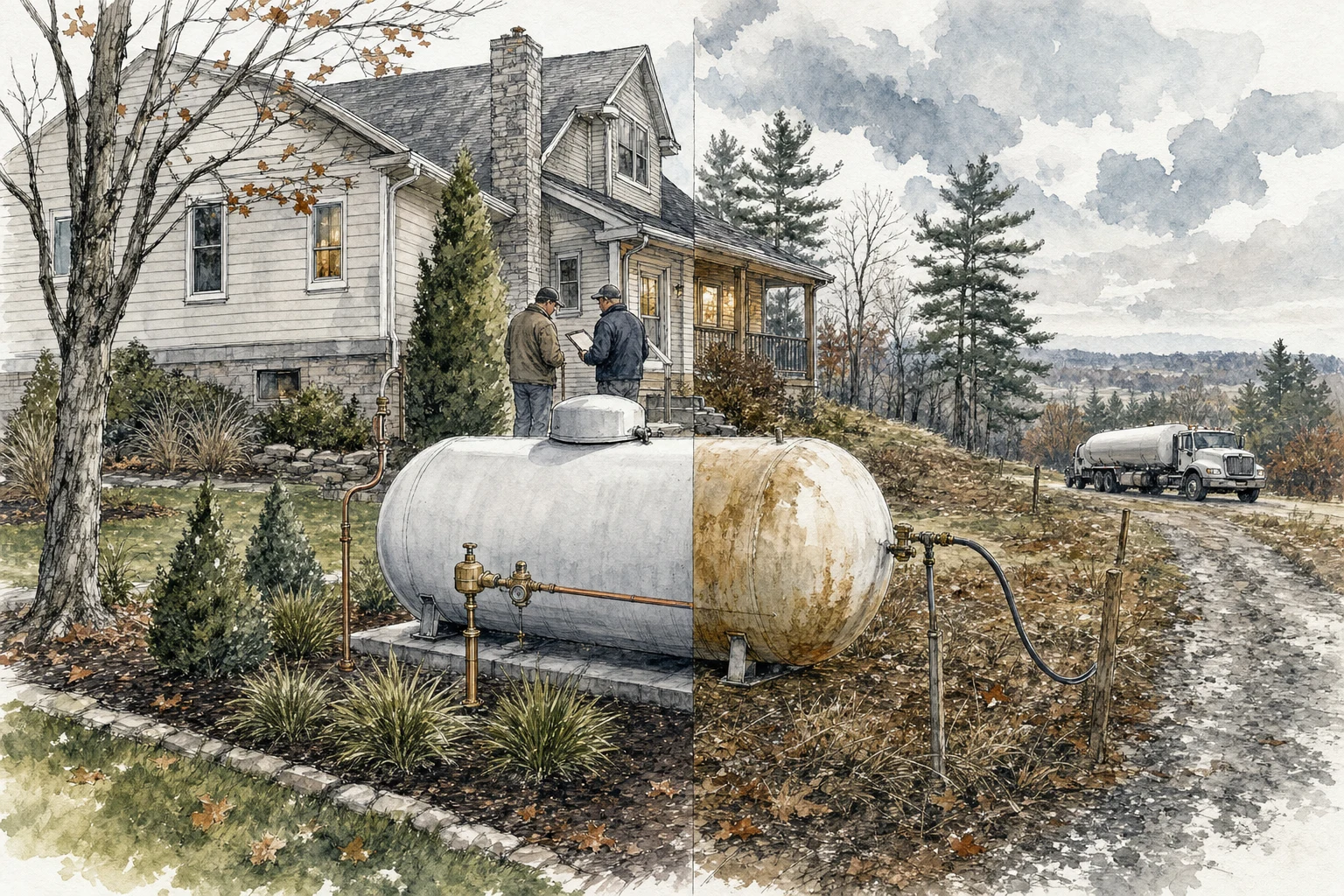
A propane tank can sit in plain sight for years, quietly doing its job, right up until the week you try to close on the house. Then the questions start: Who owns it? Can the seller “transfer” it? Will the propane company require a safety check before they’ll deliver? And if the buyer wants to switch suppliers, how fast can a new tank realistically be set?
In West Michigan, propane comes up constantly on acreage properties in Ada, Cascade, Caledonia, Byron Center, Allegan County, and anywhere you can’t (or don’t want to) connect to natural gas. The trap is that a propane system is part utility, part appliance, and part contract. Real estate contracts and disclosures do not automatically solve the “tank ownership” problem for you.
This guide is the practical, closing-focused checklist I’d want in your hands before you write an offer, list a home, or start negotiating inspection repairs.
Quick takeaways
- Do not assume the propane tank is included in the sale. Many tanks are leased from a propane provider, and the contract (not the listing) controls what happens next.
- Write the propane plan into the purchase agreement early. Decide who pays for a lease transfer, a buyout, removal, and how any remaining propane is handled.
- Switching providers can be a timeline issue, not just a price issue. New suppliers may require a safety inspection and the logistics of swapping tanks can take coordination and fees.
Why propane tanks blow up transactions (even when nothing is “wrong”)
Most closing problems are not about leaks or dramatic safety issues. They are about mismatched expectations:
- The listing implies “propane heat,” but does not specify whether the tank is owned or leased.
- The seller assumes the tank “goes with the house” because it has been there for years.
- The buyer assumes they can shop propane like they shop homeowners insurance, then learns the tank supplier controls access to the tank and may not fill a tank owned by another dealer.
The Michigan Public Service Commission (MPSC) is blunt about two important realities: propane prices are not regulated under Michigan law, and the contract sets the terms of the agreement between the customer and supplier. (That is why “we’ll figure it out later” is not a great real estate strategy.) See the MPSC tip sheet on selecting a propane provider.
Step 1: Figure out what’s actually on the property (tank, regulators, lines, and fuel)
Before you negotiate anything, inventory the propane setup like you would a well and septic system:
Is the tank owned or leased?
- Owned tank: The tank is personal property unless it’s clearly treated as part of the sale. The buyer’s big advantage is flexibility to shop suppliers, but the buyer also inherits more responsibility.
- Leased tank: The tank typically remains the property of the propane provider. In that case, the buyer may need to sign a new agreement with that provider, the seller may need to buy out the tank, or the tank may need to be removed and replaced.
The MPSC also notes a practical point that shows up in real transactions: “most propane dealers will not fill a tank owned by another propane dealer.” That one sentence explains why switching providers can be simple for some homes and a headache for others. See the MPSC “Selecting a propane provider” tip sheet.
How big is the tank and where is it?
In West Michigan you’ll commonly see 250, 500, and 1,000-gallon tanks, plus smaller cylinders for garages or standby generators. Above-ground tanks are easy to spot. Underground or mounded tanks are easy to miss, which makes early documentation important (especially if a driveway, patio, or landscaping has been built nearby).
What is included, and what is not?
Even with an owned tank, details matter:
- Are there multiple tanks (house, pole barn, pool heater, generator)?
- Is there a separate buried line to an outbuilding?
- Are any appliances excluded from the sale that rely on propane (range, dryer, fireplace insert)?
Step 2: Put the propane decision in writing (before inspection deadlines)
If propane is involved, I like the purchase agreement to answer four questions clearly:
- Is the propane tank included in the sale? If yes, specify owned tank, included with the property, and transferred free and clear.
- If the tank is leased, who is responsible for what? Spell out whether the seller must transfer/terminate the lease, buy out the tank, or remove it (and restore grading/landscaping as applicable).
- How is remaining propane handled? Decide whether remaining propane is included, credited, or handled directly through the supplier. The key is to avoid last-minute disputes over a gauge reading taken on different days.
- What happens if the buyer wants to switch providers? You can allow it, but you should acknowledge potential fees and logistics so nobody is shocked later.
Tip: this is a great place for a tight addendum rather than a vague email thread. You want the title company, lender, and both parties reading the same plan.
Step 3: Treat propane changes as a permit-and-inspection issue, not a “handyman” issue
Propane is not a DIY lane. Michigan has adopted rules that incorporate national standards for LP-gas systems. Michigan’s administrative rules for the Storage and Handling of Liquefied Petroleum Gases adopt NFPA 58 by reference, which is the core code governing LP-gas storage and handling.
On the safety side, Michigan’s Propane Safe Handling Program warns against tank tampering and makes the point plainly: only qualified propane industry professionals should modify or adjust propane systems. It also states that tampering with propane tanks is illegal. See MDHHS: Propane Safe Handling Program.
On the permit side, Michigan’s construction code framework is what gives local building departments authority over permitting and inspections. The Single State Construction Code Act (1972 PA 230) lays out building permit and inspection authority. And LARA’s Code Books page is a useful reference for which Michigan construction codes are currently effective (important when you are trying to determine what standards a local inspector is enforcing).
Practical closing advice: If the transaction requires moving a tank, adding a line to a barn, changing regulators, or converting appliances, assume you may need (1) a licensed professional, (2) permits through the local enforcing agency, and (3) time for inspection scheduling. Verify requirements with the township or city building department and your propane provider before you commit to a closing date.
Step 4: Switching providers is a process. Budget time, fees, and cold-weather risk
Buyers often ask, “Can I just call Company B after closing?” Sometimes yes. Sometimes not quickly.
According to the MPSC, if you own your tank, a new provider may charge a fee for a safety inspection prior to filling. If you do not own a tank (meaning you have a leased tank), a new tank must be leased through the new provider and specific safety regulations must be followed before the new tank can be set and the old one removed. The MPSC also notes there may be fees associated with setting a new tank and removing the old tank. See MPSC: Selecting a propane provider.
Two timing realities that matter in West Michigan:
- Heating season pressure: When it is cold, delivery schedules tighten and “we’ll swap tanks next week” can become “we’ll get there when we can.”
- Don’t run it near-empty: Michigan’s Propane Safe Handling Program warns that letting a bulk tank run nearly dry can create dangerous conditions. See MDHHS: Propane Safe Handling Program.
Seller checklist: how to prevent a propane surprise from touching your closing date
- Find the paperwork now. If the tank is leased, locate the supplier name and any lease terms. If you claim the tank is owned, be prepared to support it with documentation (invoice, paid-in-full receipt, etc.).
- Disclose clearly. “Propane heat” is not the same as “owned tank included.” Make it specific in the listing remarks and in any addenda.
- Decide how remaining propane will be handled. If you want to be done cleanly, agree to a gauge read on a specific date and a credit method at closing, or specify that remaining propane is included with no adjustment.
- If a switch is likely, plan for fees. The MPSC explicitly tells consumers to ask about fees such as installation, service, pickup/disconnect, lease or equipment rental, and minimum usage requirements. See MPSC: Selecting a propane provider.
Buyer checklist: what to confirm before you remove contingencies
- Ask in writing: “Is the propane tank owned or leased, and is it included in the sale?” Get a specific answer, not a guess.
- If it’s leased, ask who the provider is and what will be required to transfer service. Then call the provider early enough to understand next steps and any fees.
- Confirm appliance compatibility if you plan changes. If you intend to convert to natural gas later, add a fireplace, or swap a range, treat it as a planning item, not a casual weekend project.
- Do not treat “switching propane” as a same-day solution. Build time into your post-closing plan, especially if you are buying in fall or winter.
A note on larger LPG installations and special systems
Most residential propane tanks in West Michigan are below the size thresholds that trigger certain state-level plan review and certification processes. However, Michigan’s Storage Tank Division describes when it regulates the installation of new LPG systems above specific capacities and other criteria. If you are looking at a distinctive property with unusual storage capacity, multiple large tanks, or filling operations, start with LARA: LPG Systems Permits and Licenses and then verify the applicable permitting path with the correct authority having jurisdiction.
The practical next step
If you’re buying or selling a West Michigan home with propane, treat the propane tank as its own mini-transaction inside the transaction. Nail down ownership, write the plan into the contract, and give yourself time to coordinate providers and any inspections.
If you want a second set of eyes before you list or before you write an offer, I can help you pressure-test the propane language in the purchase agreement, identify the documentation to request early, and build a timeline that avoids avoidable closing delays. For more due diligence guides like this, see Switek Insights.