
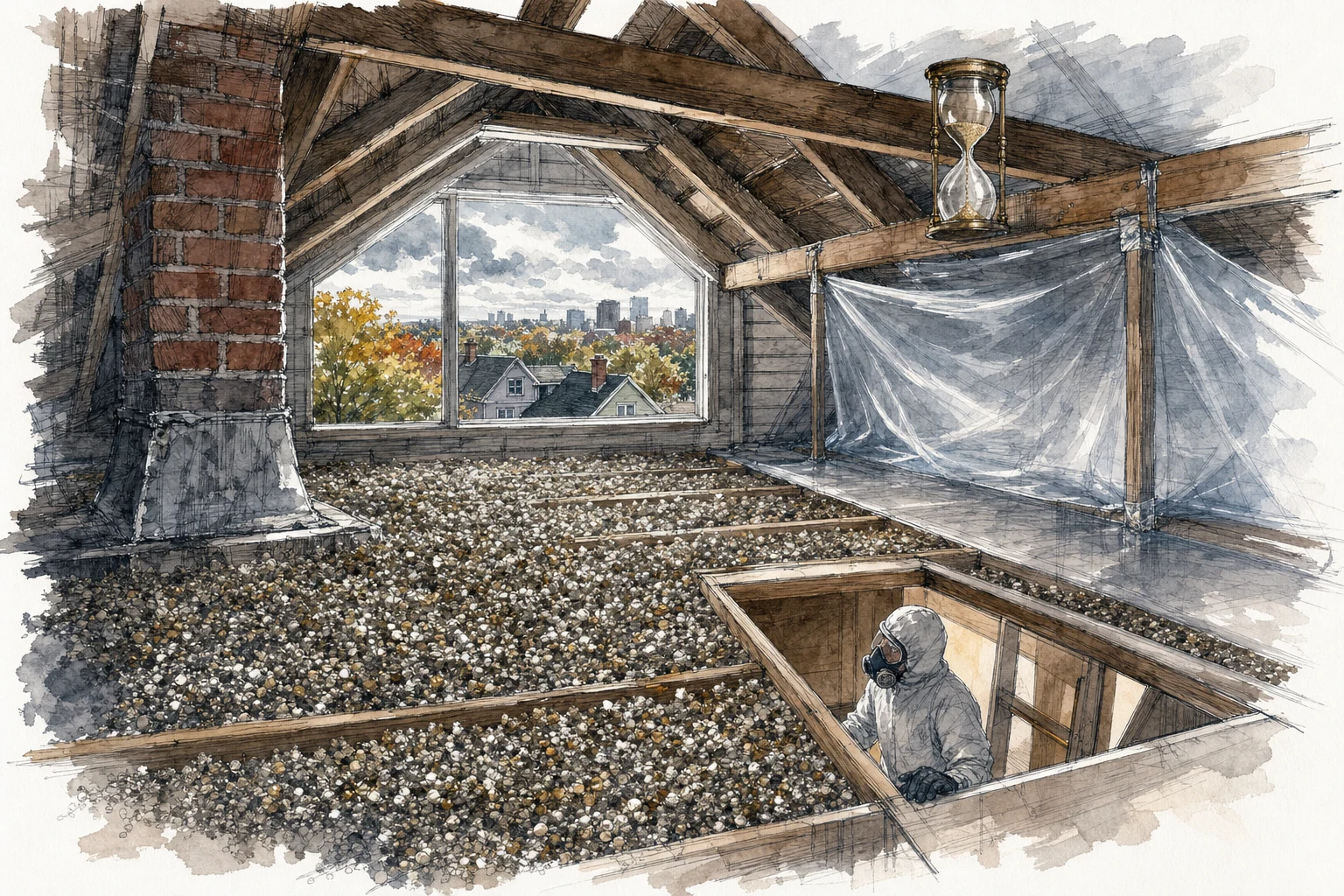
You walk through a 1950s Cape Cod in East Grand Rapids or a classic bungalow in Grand Rapids and everything feels straightforward. Then the inspector opens the attic hatch and the flashlight hits something that looks like a layer of shiny, pebble-like granola.
That is often vermiculite insulation. In West Michigan, it is common enough that it deserves its own transaction plan, especially because the “right” move is not always “remove it immediately.” Also, as of October 19, 2026, there is a very real timing issue if you are hoping to use the Zonolite Attic Insulation Trust reimbursement program.
Quick takeaways
- If you see vermiculite insulation, assume it may contain asbestos and do not disturb it. EPA guidance consistently emphasizes leaving it undisturbed unless work will disturb it.
- In a real estate deal, the risk is often schedule and scope creep. Vermiculite can complicate recessed lights, bath fans, air sealing, electrical work, and attic storage plans, which can turn into a renegotiation right before closing.
- The Zonolite Trust reimbursement changed in October 2026. If you want the higher reimbursement terms, the Trust’s current FAQ sets specific filing and completion deadlines you need to plan around.
What vermiculite insulation is (and why West Michigan keeps running into it)
Vermiculite is a naturally occurring mineral that expands into lightweight, fire-resistant pieces when heated. It was widely used as a pour-in attic insulation product for decades. The EPA’s homeowner brochure describes vermiculite attic insulation as a pebble-like, pour-in product, often light-brown or gold in color. EPA Current Best Practices for Vermiculite Attic Insulation (PDF)
The issue is not that vermiculite is “automatically” asbestos. The issue is that some vermiculite insulation, particularly material sourced from the Libby, Montana mine, may be contaminated with asbestos fibers. Because contamination can be inconsistent within the material, EPA guidance for homeowners is practical and blunt: treat it like it might contain asbestos and avoid disturbing it. U.S. EPA guidance on vermiculite insulation in attics
How to recognize vermiculite without “sampling by accident”
In a transaction, the goal is usually to identify what you are dealing with, without turning an attic visit into a dust-generating event.
Common clues
- Looks like small pebbles or flakes, not fluffy fibers.
- Shimmery under a flashlight, often gold, tan, silver-ish, or mixed tones.
- Loose-fill that pours and shifts.
Important nuance: the EPA’s general homeowner guidance is that you usually cannot confirm asbestos by sight, and if you are unsure, treat it as if it contains asbestos and leave it alone. Sampling incorrectly can be more hazardous than leaving the material undisturbed. U.S. EPA: Protect Your Family from Exposures to Asbestos
The rule-of-thumb that keeps deals and remodels from going sideways
Two lines from EPA guidance show up in real life again and again:
- Assume vermiculite may be contaminated with asbestos. U.S. EPA vermiculite Q&A
- The EPA recommends leaving vermiculite insulation undisturbed. U.S. EPA vermiculite Q&A
In other words: if it is sitting there quietly and your plans do not require disturbance, the safest and simplest strategy is often to leave it alone and manage the attic correctly. If your plans do require disturbance, the transaction needs a clear scope and a timeline.
Buying a West Michigan home with vermiculite: a practical offer-and-inspection plan
Vermiculite becomes a problem in real estate when it is discovered late, after the buyer has mentally moved into the house and the seller has mentally spent the proceeds.
1) Treat the attic like a “future scope” area
If you already see signs of vermiculite, do not plan on using the attic for storage, running new wiring yourself, or “just adding a few can lights” right after closing. The EPA brochure specifically recommends limiting attic trips, staying on floored areas, and not storing items if retrieval would disturb the insulation. EPA vermiculite best practices brochure (PDF)
2) Use the inspection period to get clarity on disturbance risk, not internet certainty
Your general home inspection can document what is visible, but asbestos identification and abatement decisions are a separate discipline. EPA guidance suggests using trained and accredited asbestos professionals for inspection and sampling, especially if remodeling could disturb materials. U.S. EPA homeowner asbestos guidance
3) Negotiate around outcomes, not fear
In West Michigan deals, the cleanest negotiation frames are usually:
- Leave it in place (if undisturbed and contained) and adjust price/credits for the buyer’s future plans.
- Remove it professionally before closing, then reinsulate so the buyer is not walking into an energy and comfort penalty.
- Remove it after closing but build the timeline and documentation into the plan so the buyer does not get stuck with an unbudgeted project on day one.
What tends to blow up closings is the “we’ll figure it out later” approach. Later is usually when the electrician says they will not work in that attic without a containment plan, and closing is two weeks away.
Seller strategy: decide early whether you are disclosing-and-leaving, or removing-and-resetting
If you are selling and suspect vermiculite, you have two defensible paths, and one risky one.
Defensible path A: leave it undisturbed, disclose clearly, and protect the buyer’s ability to plan
From a transaction standpoint, this works best when the attic is not being used as storage, the insulation is not being actively disturbed, and the buyer’s plan does not require immediate attic work. EPA guidance emphasizes that asbestos-containing materials in good condition that will not be disturbed are not likely to pose a health risk and are often best left alone. U.S. EPA: What to do if you have asbestos in your home
Defensible path B: remove it professionally, then reinsulate
This path is often about marketability and clean underwriting of “what’s next.” Buyers want to air seal, add bath fans, improve ventilation, run network cable, and upgrade lighting. Vermiculite makes all of those projects feel uncertain.
If you go this direction, do it like a professional project: written scope, cleanup plan, disposal plan, and contractor credentials.
Risky path: partial disturbance without a plan
The worst middle ground is “somebody moved it around” or “we started work and stopped.” EPA’s homeowner guidance includes basic do’s and don’ts like not sweeping or vacuuming debris that may contain asbestos and not drilling or sanding materials that may contain asbestos. U.S. EPA homeowner do’s and don’ts
Michigan oversight that matters in the real world (even in residential projects)
Michigan has multiple layers of asbestos oversight depending on what is being done and who is doing it.
- EGLE administers the asbestos NESHAP program in Michigan, aimed at minimizing asbestos fiber releases during renovation and demolition activities, and notes that advance notification is required for covered work. Michigan EGLE: Asbestos NESHAP program
- MIOSHA maintains an asbestos program with published requirements for demolition and renovation work and related worker protection standards. MIOSHA: Asbestos and Demolition/Renovation requirements (revised 3/30/2026) (PDF)
- MIOSHA also provides a “Verify and Search” tool to look up accredited individuals, licensed contractors, and training providers. MIOSHA Asbestos Program Verify and Search
Practical takeaway: if a contractor is going to disturb suspected asbestos-containing material, you want the right credentials and a paper trail, not a handshake.
The October 2026 Zonolite Trust update: if you plan to remove, timing now matters
If the vermiculite turns out to be Zonolite brand, the Zonolite Attic Insulation Trust may reimburse a portion of eligible removal and re-insulation costs for qualified claimants. The reason this matters right now is that the Trust published an October 2026 update reducing expected reimbursement levels going forward.
According to the Trust’s FAQ (updated October 2026), a reimbursement percentage adjustment was announced on October 7, 2026. The FAQ states that:
- Claims filed on or before November 30, 2026 are intended to be paid at the initial payment percentage, as long as all requirements for payment are met on or before January 31, 2027.
- Claims filed after November 30, 2026 (and claims not fully completed by January 31, 2027) are subject to the new reduced rate described in the FAQ.
Zonolite Attic Insulation Trust FAQ (October 2026 update)
Real estate implication: if you are negotiating removal, your closing timeline may not line up with the Trust’s filing and documentation workflow. If the Trust is part of your financial plan, you need a calendar, not just a quote.
Disposal: do not assume your county hazardous waste site will take asbestos
Vermiculite and asbestos waste disposal is not a “throw it in the truck and head to the transfer station” situation.
- Kent County’s Department of Public Works notes that asbestos is not accepted or allowed at DPW facilities and directs residents to contact EGLE for proper removal and disposal guidance. Kent County DPW: Building Materials (asbestos guidance)
- EGLE’s materials management guidance notes asbestos disposal is subject to federal NESHAP requirements and that landfills and abatement contractors must have provisions in place, so you should confirm whether a landfill accepts asbestos and how it must be prepared and shipped. EGLE: Landfill prohibited materials and asbestos disposal overview
Ottawa County offers household hazardous waste services for county residents, but “hazardous waste” programs do not automatically equal asbestos acceptance. Always verify what is and is not accepted before you plan your cleanup logistics. Ottawa County: Household Hazardous Waste Program
A closing-safe checklist for vermiculite (buyer or seller)
- Confirm presence. If an attic photo suggests vermiculite, treat it seriously early in the deal. Do not wait for the final walk-through to “take a look up there.”
- Decide whether your plan will disturb it. Recessed lights, bath fans, wiring changes, storage platforms, and air sealing often mean disturbance.
- If disturbance is likely, get the right professionals involved. EPA guidance recommends trained and accredited asbestos professionals for inspection, sampling, and removal decisions. U.S. EPA homeowner asbestos guidance
- Verify credentials. Use MIOSHA’s tools to verify accredited individuals and licensed contractors. MIOSHA Verify and Search
- Put the outcome in writing. If the deal includes removal, clarify: scope, who chooses the contractor, timing, documentation, re-insulation plan, and what happens if additional material is discovered.
- Do not improvise disposal. Verify EGLE guidance and landfill acceptance and packaging requirements before any material is moved. EGLE disposal overview
- If the Zonolite Trust is part of your plan, schedule backward from the deadlines. As of the Trust’s October 2026 FAQ, dates and completion requirements matter. Zonolite Trust FAQ
Practical next step: If you are buying or selling in Greater Grand Rapids or West Michigan and an attic appears to have vermiculite, bring it up before you are negotiating repairs under a deadline. A clean plan can protect your timeline, your budget, and your net, even if the best answer is simply leaving it undisturbed for now.
Note: This article is educational and is not medical or legal advice. Always confirm project-specific requirements with the appropriate agencies and qualified professionals.