
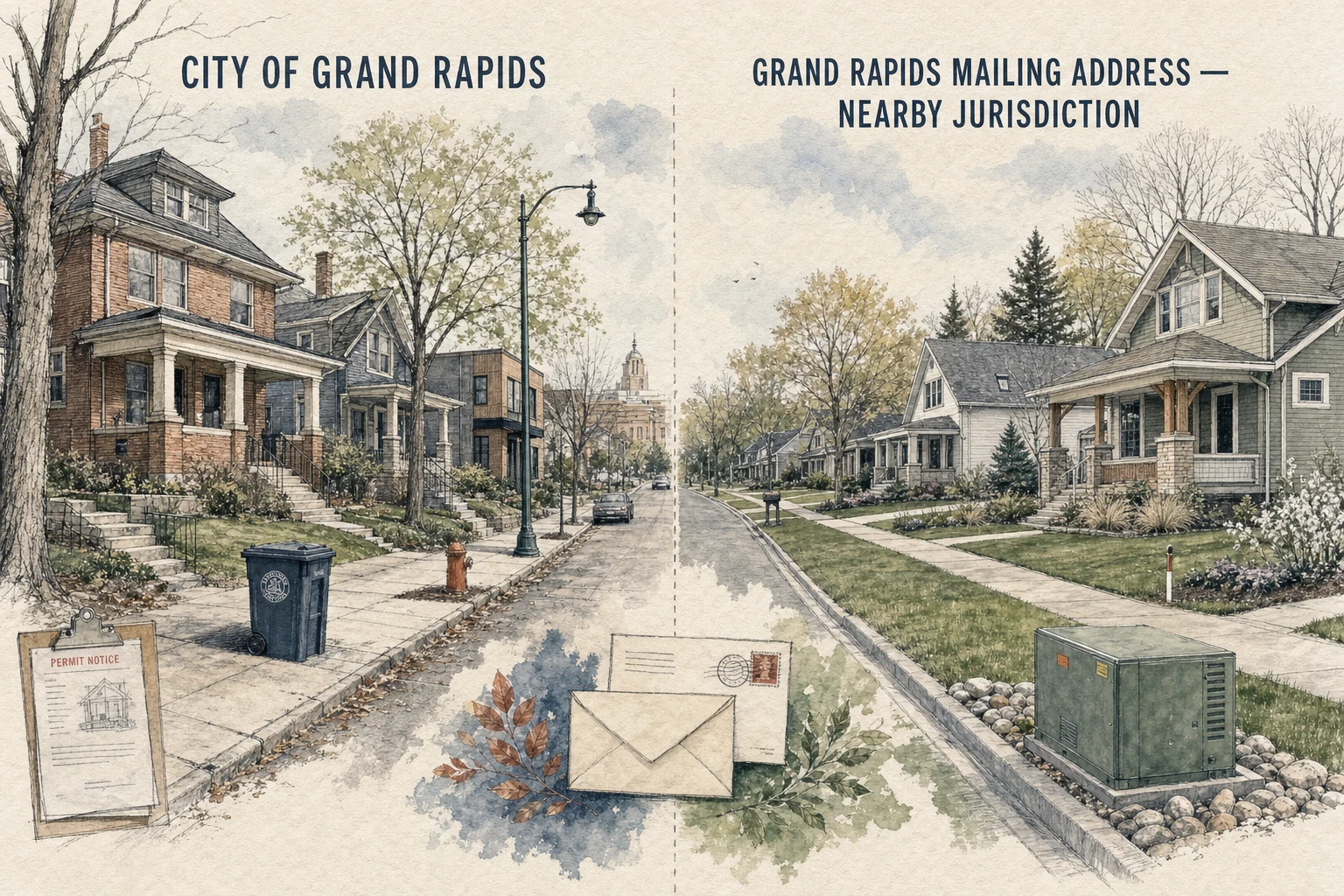
Conceptual illustration; not a specific property or location.
You can do an entire home search thinking you’re “moving to Grand Rapids” and not realize you’re actually choosing between two different ownership experiences.
Because in West Michigan, “Grand Rapids” shows up as a mailing address, a ZIP code, an employer location, a cultural center, and also a specific legal boundary. Real estate sites do not always make that boundary feel urgent. Your paycheck and your to-do list will.
This article is about one deceptively simple relocation question that changes your annual taxes, your renovation workflow, and even who you call when something breaks.
Quick takeaways
- Grand Rapids city limits can add a real recurring cost. The City of Grand Rapids individual income tax rate is listed as 1.5% for residents and 0.75% for nonresidents (for tax years beginning after July 1, 2010). City of Grand Rapids Income Tax Guide for Individuals
- “Grand Rapids address” is not the same as “City of Grand Rapids.” Before you buy, confirm the property’s actual municipality using tools like the Kent County GIS resources and the jurisdiction information referenced by the City income tax department. City of Grand Rapids Individual Taxpayers page
- City vs. non-city affects day-to-day homeownership mechanics. Things like permits, neighborhood rules, and how you request city services often route through City systems like GR311 and the City’s homeowner guidance. Grand Rapids Neighborhood Living Guide (PDF)
The first thing to verify: Are you inside the City of Grand Rapids?
Here’s the part that trips up relocations: you can have a “Grand Rapids, MI” mailing address and still be outside the City of Grand Rapids limits. That can mean different taxes, different ordinances, different permit offices, and sometimes different service providers.
How to check (without guessing)
- Use parcel mapping, not a ZIP code. Start with Kent County’s GIS tools and parcel viewers to see the actual jurisdiction tied to the parcel. Kent County GIS
- Use the City income tax office’s residency tools. The City’s Income Tax department points residents to a Kent County-maintained street directory to confirm whether an address is considered within Grand Rapids for income tax purposes. City of Grand Rapids Individual Taxpayers page
- When a property is near a boundary, assume nothing. The City notes that some locations can be partially in and partially out of the City. If you are looking at boundary-adjacent homes, verify early, not after you’ve mentally moved in. City of Grand Rapids Individual Taxpayers page
The money question: Grand Rapids income tax (and when it applies)
If you’re coming from a region where local income tax is rare, this is the “Wait, what?” moment.
What the City publishes (rates and who files)
The City of Grand Rapids publishes an individual income tax guide that lists the rates as 1.5% for residents and 0.75% for nonresidents (for tax years beginning after July 1, 2010). City of Grand Rapids Income Tax Guide for Individuals
The same guide also draws the key distinction that relocating buyers should understand:
- Residents: the City states that a resident is subject to tax on items included in total federal income, including compensation “regardless of where earned.” Income Tax Guide for Individuals
- Nonresidents: the City states that a nonresident is subject to tax on items included in total federal income if they are from or connected with Grand Rapids sources, including compensation for services provided as an employee in city limits. Income Tax Guide for Individuals
Two common relocation scenarios (illustrative, not tax advice)
Hypothetical example (for intuition only):
- You live in the City and your employer is in another city or you work remotely. The City’s guide indicates residents are taxed on compensation regardless of where earned. That means the “I don’t commute downtown” argument does not automatically remove City tax exposure. Verify specifics with a CPA for your situation. Income Tax Guide for Individuals
- You live outside the City but work inside City limits. The City’s guide frames nonresident taxation around Grand Rapids source income, including work performed in City limits. For hybrid and multi-location work, allocation can get nuanced quickly. Income Tax Guide for Individuals
Zooming out: Grand Rapids is not the only Michigan city with income tax
When you’re comparing “City of GR” vs. “just outside,” also remember you may be choosing between one city income tax and another. Michigan Treasury maintains a reference list of cities that impose an income tax. Use it as a starting point when you’re evaluating addresses across municipal lines. Michigan Department of Treasury: Cities that impose an income tax
Homeownership reality: City systems, rules, and how problems get solved
Even if the homes look similar on a showing day, the ownership logistics can feel different a month after closing.
311 and “who do I call?” becomes a real lifestyle feature
The City of Grand Rapids routes a lot of day-to-day service requests through GR311, described as “your one call to City Hall.” When you’re inside City limits, this can influence how you report issues, ask questions, and get routed to the right department. GR311 Customer Service
The City’s Neighborhood Living Guide (PDF) is also worth skimming even before you buy. It’s written around common resident questions and covers practical topics that show up fast after closing: permits, sidewalks, trash and yard waste, and more.
Trash, recycling, yard waste: the details are not identical across the metro
Inside the City, the City publishes service information through its Public Works Materials Management department, including curbside yard waste season timing and other program details. City of Grand Rapids Materials Management
The Neighborhood Living Guide also describes how recycling is handled and outlines yard waste season timing and options. Neighborhood Living Guide (PDF)
Outside City limits, refuse and recycling might be handled by a different municipality or by private haulers. Translation: when you tour homes across boundaries, you’re not just comparing kitchens. You’re comparing systems.
Renovations, additions, and permits: your future projects have an address too
Relocating buyers often focus on “Can I picture it?” The better question is: “Can I actually execute the projects I’m imagining without friction?”
The City’s Neighborhood Living Guide emphasizes that permits are required for many home projects and explains why permits and inspections matter, including the practical reality that permit and inspection records are publicly available. Neighborhood Living Guide (PDF)
If you’re shopping both inside and outside the City, treat the permit process as part of the lifestyle. Different jurisdictions have different workflows, timelines, and rules. That is not good or bad. It is just real.
Utilities can cross borders: your water bill might still be “Grand Rapids”
Municipal boundaries do not always match utility boundaries.
As one clear example, the City of East Grand Rapids notes that usage charges cover the costs of purchasing water and treating sewer, which is passed on through the City of Grand Rapids. City of East Grand Rapids: Water Billing & Payments
The practical takeaway: when you’re comparing addresses, confirm whether the home is on municipal water and sewer, who bills it, and whether it’s tied to a City program or a separate municipality. Do not assume “outside the City” automatically means well and septic, and do not assume “inside the City” automatically means the same billing setup as every other City property.
One more paperwork item that affects your property taxes: Michigan’s PRE
This is Michigan-wide, but relocations miss it constantly because it’s not a “Grand Rapids thing.”
Michigan’s Principal Residence Exemption (PRE) is claimed by filing the PRE affidavit (Form 2368) with the local assessor, if you qualify. Michigan Treasury’s guidance explains filing timing and that filing on or before June 1 can reduce that year’s property taxes beginning with the summer tax levy. Michigan Treasury: PRE claim requirement
Form access and instructions are published by the State. Michigan Treasury: Principal Residence Exemption forms
This is not tax advice, and eligibility can be fact-specific. The point is simple: whether you buy inside the City of Grand Rapids or a nearby township, the assessor paperwork still matters.
The lifestyle tradeoff is real, but it’s not just “urban vs. suburban”
People talk about city limits like it’s purely a vibe decision. In practice, it’s a bundle decision:
- Recurring costs (like income tax exposure, depending on residency and work location). Income Tax Guide for Individuals
- How homeowner tasks get done (311 requests, published homeowner rules, and department workflows). GR311
- How future renovations play out (permits, inspection records, and jurisdiction-specific requirements). Neighborhood Living Guide (PDF)
None of those items show up in a listing photo. All of them show up in real life.
A practical next step before you tour 10 houses
If you’re relocating and your saved homes are a mix of “Grand Rapids addresses,” pick your top 3 and do a quick jurisdiction check first. If you want a second set of eyes, send me the addresses you’re considering and tell me how you’ll live in the house (work location, remote schedule, renovation plans, and what you want your weekdays to feel like). I’ll help you sort out which ones are truly City of Grand Rapids, what that changes, and what you should verify before you write an offer.