
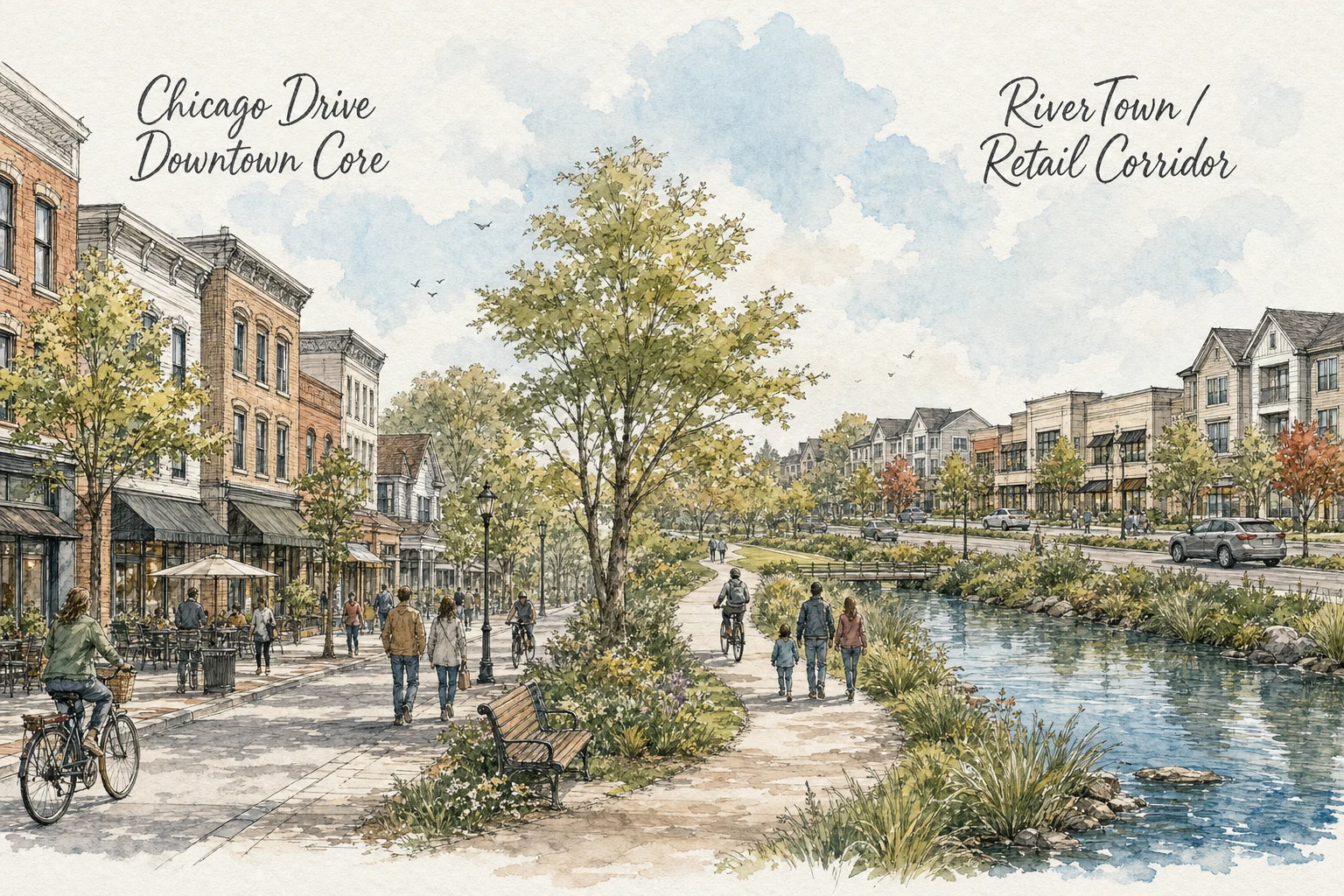
Conceptual illustration; not a specific property or location.
Grandville is one of those West Michigan moves people think they understand… until they try to live it.
Because “Grandville” can mean two very different day-to-day routines. One is a Chicago Drive rhythm: coffee, bakery runs, a surprisingly legit little downtown strip, and a life where you’re more likely to walk a few blocks for something. The other is a Rivertown Parkway and big-corridor routine: retail convenience, restaurants and errands stacked back-to-back, and a home search that quietly prioritizes driveway logistics over charm.
If you’re relocating, that choice matters more than the floorplan. It changes the streets you’ll tolerate, the kind of house that feels “easy,” and what you’ll actually do after work when you’re tired and the novelty of the move is gone.
Quick takeaways
- Grandville buyers are usually choosing between two lifestyles: a smaller-scale Chicago Drive “downtown-first” routine or a “corridor-first” routine near the retail and freeway grid.
- The overlooked quality-of-life perk is trail and park access, including the paved Kent Trails system that runs through Grandville and connects to a wider network. (Kent County Parks: Kent Trails)
- Ownership homework here is very location-specific: traffic noise, future road projects, HOA rules, and (in some pockets) floodplain and wetland considerations near the Grand River corridor. (City of Grandville Master Plan (PDF), FEMA NFIP: Flood maps and Map Service Center info)
The two daily routines most Grandville moves are really about
1) “Downtown-first” Grandville (Chicago Drive and the DDA district)
Grandville’s Downtown Development Authority district is anchored around the Chicago Drive corridor. It’s the version of Grandville where a Saturday can start with a quick coffee run and end with “we ran into three people we know” energy, without needing to drive across town. The DDA’s own description of the district puts the focus downtown and along the Chicago Drive and 28th Street corridors. (Grandville DDA)
In this routine, walkability is not a promise. It’s block-by-block. But you do have real, currently operating stops that make “pop out for a few minutes” feel normal, including Wildroast Coffee Co. (Grandville location), Oakestown Brewery, Michigan Moonshine, and Steenstra’s Royal Dutch Bakery.
2) “Corridor-first” Grandville (Rivertown, 28th Street, and the errand grid)
The other lifestyle is less “downtown” and more “everything is five minutes away if you time it right.” RiverTown Crossings sits at the center of a huge shopping and dining cluster, and the mall itself explicitly positions Grand Rapids as the nearest city and about six miles away. (RiverTown Crossings FAQ)
That detail is useful, not as trivia, but as a clue: this part of the map often appeals to relocating buyers who want to be close to the region’s job centers while keeping everyday errands easy and predictable. It’s also where traffic patterns and access points matter. Two homes can be the same price and feel totally different, purely based on whether you can get out of your neighborhood without playing “left turn roulette.”
What living here can feel like (a realistic, non-touristy Saturday)
Here’s a practical way to picture Grandville, without pretending you’re moving for a postcard.
Illustrative example: You start in the Chicago Drive area with coffee at Wildroast or swing by Steenstra’s for something that immediately makes you feel like you should have invited friends over. If you’re the “local-business loop” type, you can layer in a stop at Littlefoot Coffee Roasters’ Grandville roastery or a quick ice cream run at Tippy Cow Ice Cream.
If your brain relaxes when you can complete errands in one concentrated run, you pivot to the RiverTown area. The mall is built for that: the site even notes that mall walkers can enter an hour before stores open. (RiverTown Crossings FAQ)
And if you need your weekend to include outdoor time that feels like a reset, not just “we drove to a park,” Grandville’s trail connections become the quiet differentiator. The paved Kent Trails system runs through Grandville as part of a multi-jurisdiction collaboration, which makes it easier to build exercise and fresh air into regular life, not just special occasions.
Homes in Grandville: the patterns that show up once you stop searching by price
Grandville’s housing mix tends to fall into a few buckets, and each one comes with a different ownership experience.
1) Older neighborhoods closer to the Chicago Drive core
This is where you’re more likely to find the “character trade” that relocating buyers either love or hate: older layouts, potentially tighter lots, and the need to pay attention to big-ticket updates. The reward is lifestyle proximity. The risk is underestimating maintenance and renovation scope because the house feels charming in photos.
Ownership lens: If you’re shopping here, your inspection priorities can shift toward age-related systems and past remodel quality. (Not a Grandville-only issue, just a reality of older housing stock.)
2) Post-war and late-20th-century neighborhoods that live like classic suburbs
This is the “I want a driveway, a garage, and a floorplan that makes sense” segment. You can still be close to the Chicago Drive amenities, but the day-to-day feels more private and car-oriented. Many relocating buyers land here because it’s a comfortable middle ground between downtown Grand Rapids density and exurban acreage.
Ownership lens: Expect more variability in lot shape, tree cover, and the feel of the street. Two similar houses can live differently depending on how cut-through traffic behaves.
3) Newer subdivisions and convenience-first pockets near the retail corridors
This is where “easy” can mean newer mechanicals, newer roofs, HOA-managed common areas, and a shorter list of immediate projects. But it also tends to mean living closer to higher-traffic routes and commercial activity.
Ownership lens: Read HOA documents early if they exist. Many buyers wait until after they fall in love with the kitchen, and that’s backwards. Restrictions on fencing, outbuildings, parking, or even exterior changes are easier to accept before you’re emotionally committed.
Parks, trails, and the part of Grandville many movers miss on the first visit
If you’re relocating, you’ll probably do the RiverTown loop. You might do a quick downtown pass. But a lot of people don’t test-drive the outdoor layer that actually affects weeknight life.
Start with Kent Trails, a paved, non-motorized trail system that runs through Grandville and connects with surrounding communities. If you’re the type who wants a run, a dog walk, or a bike ride to be “right there,” this matters more than an extra half-bath.
Then there’s the bigger regional park layer nearby, including Millennium Park (Kent County), which is the kind of asset that makes it easier to live in a suburban footprint without feeling like your outdoor life is limited to your backyard.
Within Grandville itself, the city has made ongoing investments in park space. For example, FOX 17 reported on construction and upgrades at Mill Race Park. (FOX 17: Mill Race Park upgrades)
Buying a home in Grandville: the ownership homework that pays off
Grandville is not a “gotcha” market. But it is a market where the right diligence depends heavily on where, exactly, the home sits.
- Floodplain and water considerations (location-dependent): Grandville’s planning documents note floodplains in parts of the city, especially closer to water features like the Grand River corridor. Before you assume anything, check the property on FEMA flood maps via the Map Service Center. (City of Grandville Master Plan (PDF), FEMA NFIP contact and flood map info)
- Traffic, sound, and access: Homes near Chicago Drive, 28th Street, or major connectors can feel very different at 5:30 p.m. than they do at noon on a Sunday. If you’re touring from out of town, try to schedule at least one drive-by during a typical weekday peak window.
- Watch the future street changes: The City has been discussing changes intended to make parts of Chicago Drive more pedestrian-friendly, including lane reductions and new public-space concepts, according to local reporting. If you’re buying along a corridor, future design matters. (FOX 17: Chicago Drive plans)
- Match the house to your real routine: If your life is “downtown-first,” prioritize the street grid and the blocks you’ll actually walk. If your life is “corridor-first,” prioritize how quickly you can get to the freeway and whether your errands feel frictionless.
Grandville vs. nearby alternatives (when you’re close but the lifestyle changes)
If you’re on the fence, it often helps to compare Grandville to what sits right next to it on the map.
- If you want a more city-neighborhood feel, some buyers also explore nearby Grand Rapids neighborhoods (with different housing character and municipal considerations).
- If you want more “newer subdivision” inventory, you may end up looking at adjacent communities where development patterns differ.
- If you want more land, you’ll likely start pushing outward, and the trade becomes lot size versus drive-time and convenience.
The point is not that one is better. It’s that “close” does not mean “the same,” especially once your daily routes are set.
If you tell me where you’re moving from, what you want your normal Tuesday to look like, and whether you’re a downtown-first or corridor-first person, I’ll help you narrow the exact pockets of Grandville (and the nearby alternatives) that fit before you burn weekends on the wrong showings.