
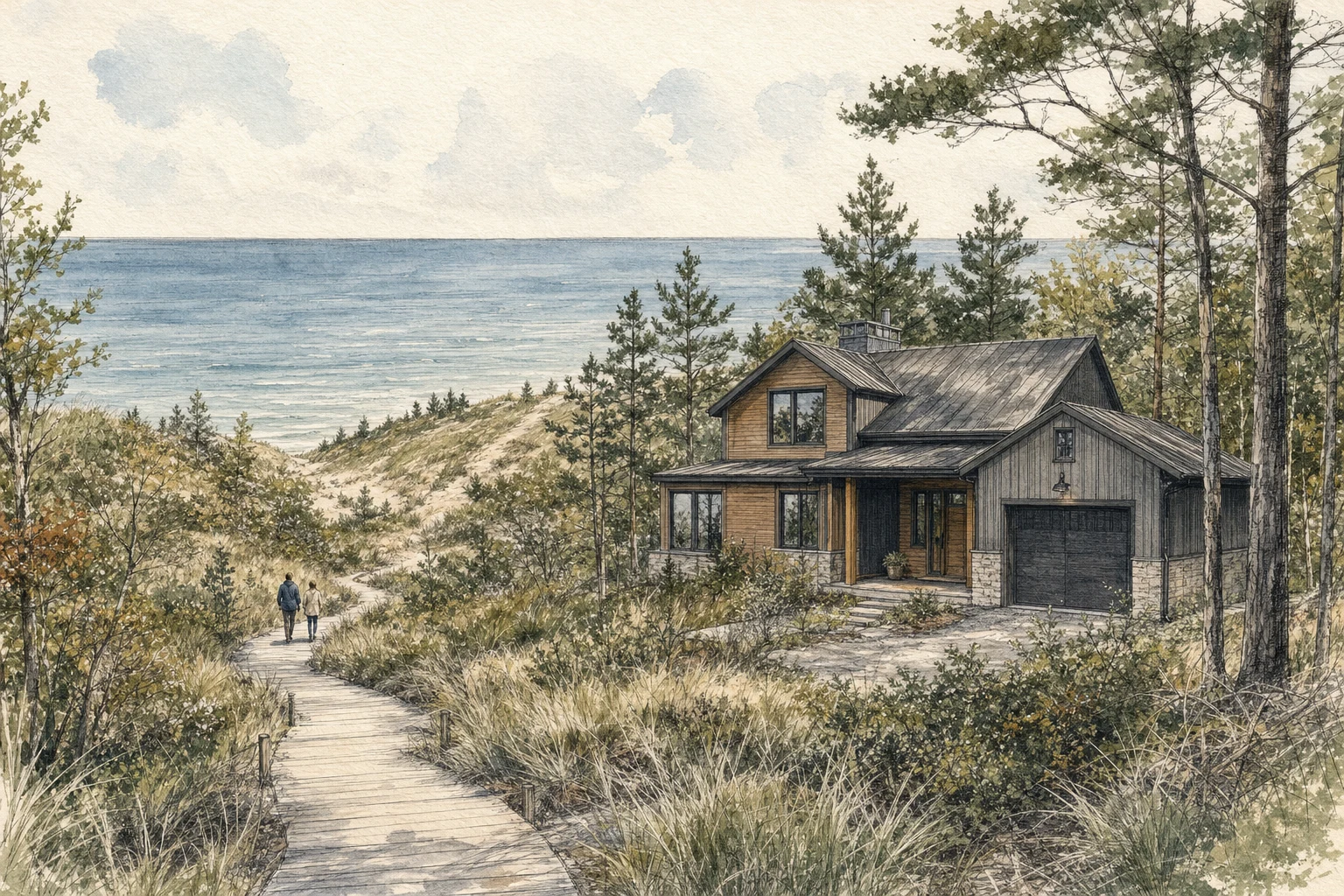
Conceptual illustration; not a specific property or location.
If you’re looking at the Holland and Saugatuck coastline, Laketown Township is the option that quietly changes the whole premise of your move.
You’re not choosing a “town” with a main street and a Saturday-night scene. You’re choosing a daily-life map: Lake Michigan dunes on one edge, Lake Macatawa and the Holland area on another, and a lot of neighborhoods where the most important amenity is what you can walk into from your driveway. That’s the appeal. It’s also the ownership test.
Because when you buy in Laketown, your house needs to function without a downtown safety net. Your storage matters. Your outdoor rinse-off matters. Your trail access matters. Your short-term rental assumptions matter. Your permitting and “can I touch this dune?” questions matter. A lot.
Quick takeaways
- Laketown is a location-first move: you live between Holland and Saugatuck, but you don’t “live in” either. You’ll use both, plus the parks inside the township.
- The lifestyle is parks, dunes, and routes: Laketown Beach, Shore Acres, Sanctuary Woods, and Saugatuck Dunes State Park shape what weeknights and weekends actually feel like.
- Ownership here can be permit-heavy and rule-sensitive: Lake Michigan shoreline, critical dune regulation, and evolving short-term rental rules can change what a property can realistically do.
Laketown Township, in plain English
Laketown Township sits on Lake Michigan between Holland and Saugatuck, in Allegan County. The township itself describes its setting as “along Lake Michigan between Holland and Saugatuck,” with a “rural, non-commercialized environment” anchored by multiple parks and outdoor recreation. (Laketown Township: Welcome to Laketown)
Translation for a relocating buyer: Laketown is not about walking to a storefront district. It’s about choosing how close you want to live to dunes, woods, and water, and how you want to access them: on foot, by bike, or by car with a predictable parking plan.
The daily-life map: beach in one direction, errands in the other
In Laketown, you’ll feel the “between” immediately. The north edge pulls you toward Holland’s services, dining, and year-round infrastructure. The south pull is Saugatuck and Douglas when you want coastal energy, galleries, and that “I’m on the lakeshore” vibe.
And because Laketown doesn’t have a dominant downtown of its own, your routines tend to become destination-based. A coffee run might be into Saugatuck for Uncommon Coffee Roasters. A dinner that feels like a punctuation mark at the end of the week could be something like The Southerner. If you like a restaurant that doubles as a lifestyle signal, Pennyroyal Cafe & Provisions is right on Blue Star Highway. None of those are “Laketown businesses” in the municipal sense, but they are absolutely part of how Laketown owners live.
The question to ask yourself is simple: Do you want your everyday to be “close to a downtown,” or do you want your everyday to be “close to the dunes”? Laketown is the second one.
Where you actually go outside (and why this can feel like a private club, but isn’t)
Laketown’s lifestyle advantage is that a lot of the good stuff is not a single marquee attraction. It’s a network. The township maintains multiple parks and also sits next to one of the most important natural areas on this part of the Lake Michigan coast.
Laketown Beach and Shore Acres: the “local access” story (with a real-time catch)
Laketown Beach is the township’s signature Lake Michigan access, and it’s exactly what you picture: big dune, big sky, big shoreline. But Laketown also posts very practical, very current access updates. As of October 9, 2026, the township notes the entrance leading to the stairs is closed while crews install new stairs, and it directs visitors to watch for reopening notices. (Laketown Township: Laketown Beach updates)
This is not a minor detail for homeowners. If your lifestyle plan includes “walk to the beach,” your plan needs a backup route for when dunes, stairs, and erosion projects change access.
That’s where Shore Acres Township Park becomes more than a disc golf stop. Laketown notes that visitors can reach Lake Michigan via Shore Acres by using trails that connect into Saugatuck Dunes State Park. (Laketown Township: Shore Acres access notes)
Saugatuck Dunes State Park: the “you’ll actually use it” state park
Saugatuck Dunes State Park is one of the defining ownership perks of this area. The DNR describes it as having 2.5 miles of Lake Michigan shoreline, 13 miles of trails, and the 300-acre Patty Birkholz Natural Area. It also calls out a practical reality: the .75-mile one-way Beach Trail is the shortest route to the beach. (Michigan DNR: Saugatuck Dunes State Park)
For buyers used to “park next to the sand,” that trail distance changes the experience. But for buyers who want the dunes to feel like a preserve, not a boardwalk, it’s the whole point.
Sanctuary Woods and the ‘views cost effort’ theme
Sanctuary Woods is a good example of Laketown’s rhythm: trails through woods and along a creek, then stairs, then the payoff. The township notes 170 steps and views toward Lake Macatawa and Lake Michigan. (Laketown Township: Sanctuary Woods)
That “views cost effort” theme shows up everywhere along this coast. It’s worth embracing early because it influences what kind of property will make you happiest.
Conserved dunes you can’t ‘improve’ into something else
For a quieter walk, the Dune Pines Nature Preserve protects a forested dune ecosystem and includes a 0.6-mile loop trail according to the Land Conservancy of West Michigan. (Land Conservancy: Dune Pines Nature Preserve)
And the Castle Park Nature Reserve is even more revealing: it’s accessed by walking along the beach, it’s in a designated critical dune area, and it’s being actively restored. (Land Conservancy: Castle Park Nature Reserve)
That’s not just nice-to-know. It’s the region telling you what it values, and what your property may be asked to comply with.
Homes here: three very different Laketown searches
In Laketown, “I want to be near the lake” can mean three completely different buying experiences.
1) Lake Michigan frontage and dune-adjacent properties
This is the postcard search. It can also be the most complicated search. The big tradeoffs are rarely about countertops. They’re about erosion exposure, stair and access logistics, and what you are allowed to build, replace, or stabilize.
2) Backdune neighborhoods: ‘close enough’ without being on the edge
These homes can deliver the lifestyle without the most intense shoreline variables. You may still be in or near regulated dune systems, but you’re often buying more day-to-day practicality: garages that actually fit the gear, easier year-round access, and fewer “the lake decides” days.
3) Rural lanes and larger parcels
Laketown’s own description leans “rural” and “non-commercialized,” and you can feel it once you move away from the immediate coastline. (Laketown Township: Welcome to Laketown) If you want privacy, outbuildings, or simply more breathing room, this version of Laketown can be the sweet spot. Just remember: rural often means a different utility and maintenance profile, and you should verify each property’s specifics during due diligence.
Due diligence that matters more here than in a normal suburb
Critical dunes: assume the dunes have rules until proven otherwise
Michigan regulates development and certain activities in designated Critical Dune Areas. EGLE notes that these areas include public and private properties where regulated activities require a permit under Part 353, Sand Dunes Protection and Management. (EGLE: Critical Dune Areas Program)
EGLE also provides tools to determine whether a property is in a Critical Dune Area, including the Critical Dune Atlas and the MiEnviro Site Map Explorer. (EGLE: Maps of Critical Dune Areas)
Practical takeaway: if you’re buying anywhere near the lakeshore in Laketown, confirm CDA status early, before you fall in love with a renovation plan.
State park adjacency: a perk, and a pattern of use
The DNR’s Saugatuck Dunes page explicitly ties the park to adjacent destinations like the Felt Estate and Shore Acres Township Park. (Michigan DNR: Saugatuck Dunes State Park) That adjacency matters for owners. It’s the difference between “we should go sometime” and “we can do a quick trail loop after work.”
Short-term rentals: don’t buy a ‘maybe’ business plan
Rules change quickly on the lakeshore. Laketown has been actively revising its approach to short-term rentals, including a proposal described by the township as prohibiting new stand-alone homes from being used as STRs in residential zoning districts, while allowing certain owner-occupied configurations depending on zoning. (Laketown Township: STR ordinance changes (May 2026)) Local reporting also covered the township’s approval of restrictions on future stand-alone rentals in certain zones. (WGVU: Laketown STR rules coverage)
If STR potential is part of your purchase logic, verify the current ordinance text in the township’s codified code, not a blog post or a listing description. Laketown links to its Code of Ordinances via Municode. (Laketown Township: Ordinances & Legal Notices)
Laketown vs. the alternatives (a fast comparison)
If you want a true walk-to-dinner coastal town: you will likely feel more at home in Saugatuck or Douglas, where the downtown experience is the point.
If you want a Holland-first lifestyle: look north toward the Holland area and Park Township. Laketown can still work, but your default routes matter.
If you want dunes and outdoors as the headline: Laketown is hard to replicate because it stacks township parks, preserves, and a major state park right into everyday reach.
A smart next step if Laketown is on your shortlist
If you’re considering Laketown Township, send me (1) the addresses you’re circling and (2) what you want your regular week to look like: beach walks, mountain bike loops, quiet woods, or a mix. I’ll help you pressure-test the location and the ownership details that actually control your experience here, especially beach access, critical dune questions, and any short-term rental assumptions.